Audit & data mapping
Mapped the existing PACS worklist, queue data and radiologist review patterns to find where urgency signals were being lost to FIFO ordering.

Imaging-triage AI that flags urgent studies first, cutting turnaround on critical cases from a day to under an hour. Runs inside the existing PACS workflow, with clinicians retaining full override control.
 MedAI Live
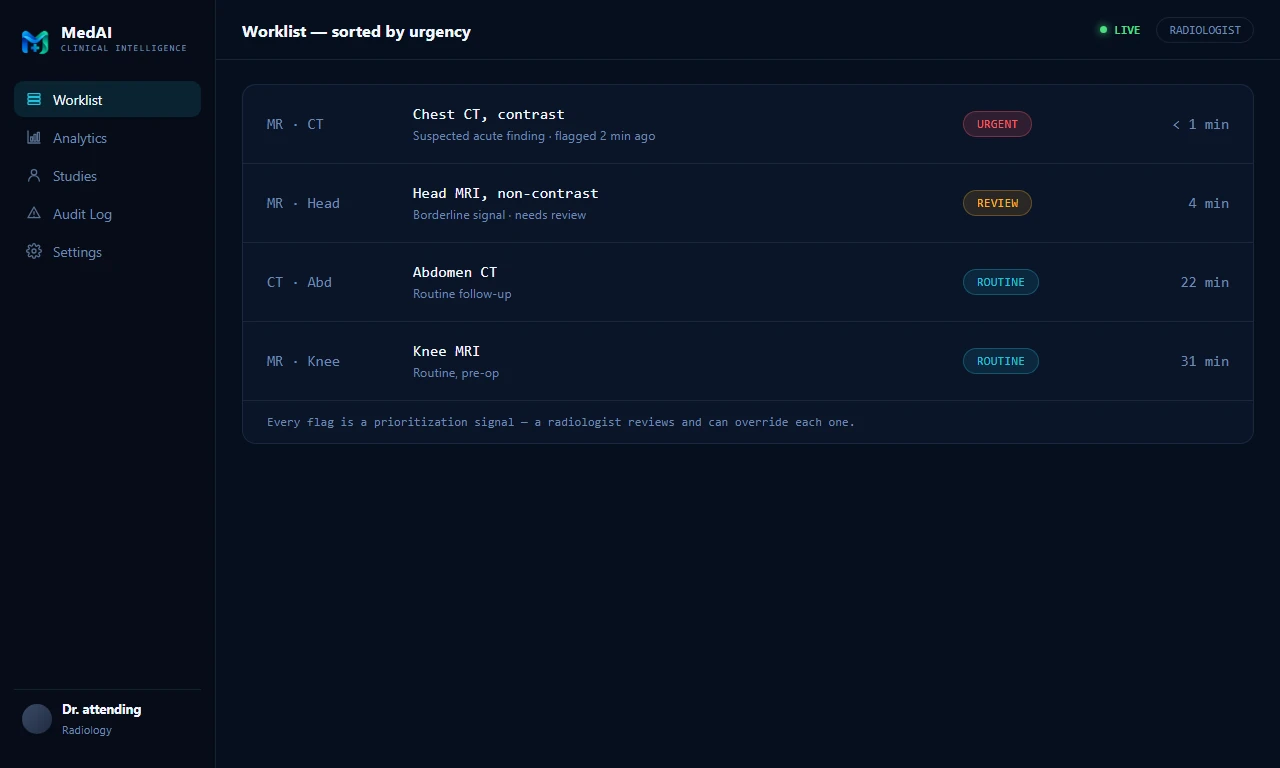
The worklist radiologists see the moment they sign in — sorted by urgency, not arrival time.
A routine clinical-governance review flagged that critical-finding turnaround was being driven by queue position, not urgency — a same-day fix wasn't optional once it was logged as a patient-safety risk. That set a hard deadline: something live before the next quarterly review, not a multi-year platform overhaul.
Cut urgent-case turnaround by re-prioritizing the imaging review queue on clinical urgency, not arrival order.
Why 12 weeks was realistic, not a marketing number — the scope was one model and one integration point, not a platform rebuild. Here's the breakdown:
Mapped the existing PACS worklist, queue data and radiologist review patterns to find where urgency signals were being lost to FIFO ordering.
Trained the urgency-scoring model on imaging metadata and validated it against radiologist-labeled priority calls before it touched a live queue.
Wired the scoring layer directly into the existing PACS worklist — no separate login, no new interface for radiologists to learn.
Rolled out with full override control from day one, then tuned the model on real override activity during the first weeks live.
The stack behind Meridian's real-time urgency-scoring layer.
Plus PACS/DICOM and HL7 integration into Meridian's existing clinical systems — the connective work most off-the-shelf AI vendors skip.
Radiology and clinical teams were reviewing imaging studies in strict FIFO order, so studies with urgent findings sat in the same queue as routine follow-ups. Turnaround on genuinely critical cases stretched to a full day, driven by queue position rather than clinical urgency.
We built an imaging-triage layer that scores incoming studies for urgency signals and re-orders the review queue in real time, surfacing likely-urgent studies to the top without removing a clinician from the loop — every flag is a prioritization signal, not an autonomous diagnosis. The system integrates with the existing PACS workflow so radiologists work from the same interface, just a smarter queue.
Every incoming study is scored for likely-urgent findings the moment it lands.
The review queue re-sorts in real time as new studies arrive — no manual triage.
Runs inside the existing PACS interface radiologists already use, zero new tools to learn.
Every AI flag is a suggestion a clinician can accept, deprioritize, or override outright.
The urgency-scoring worklist radiologists use every shift, from sign-in to audit trail.
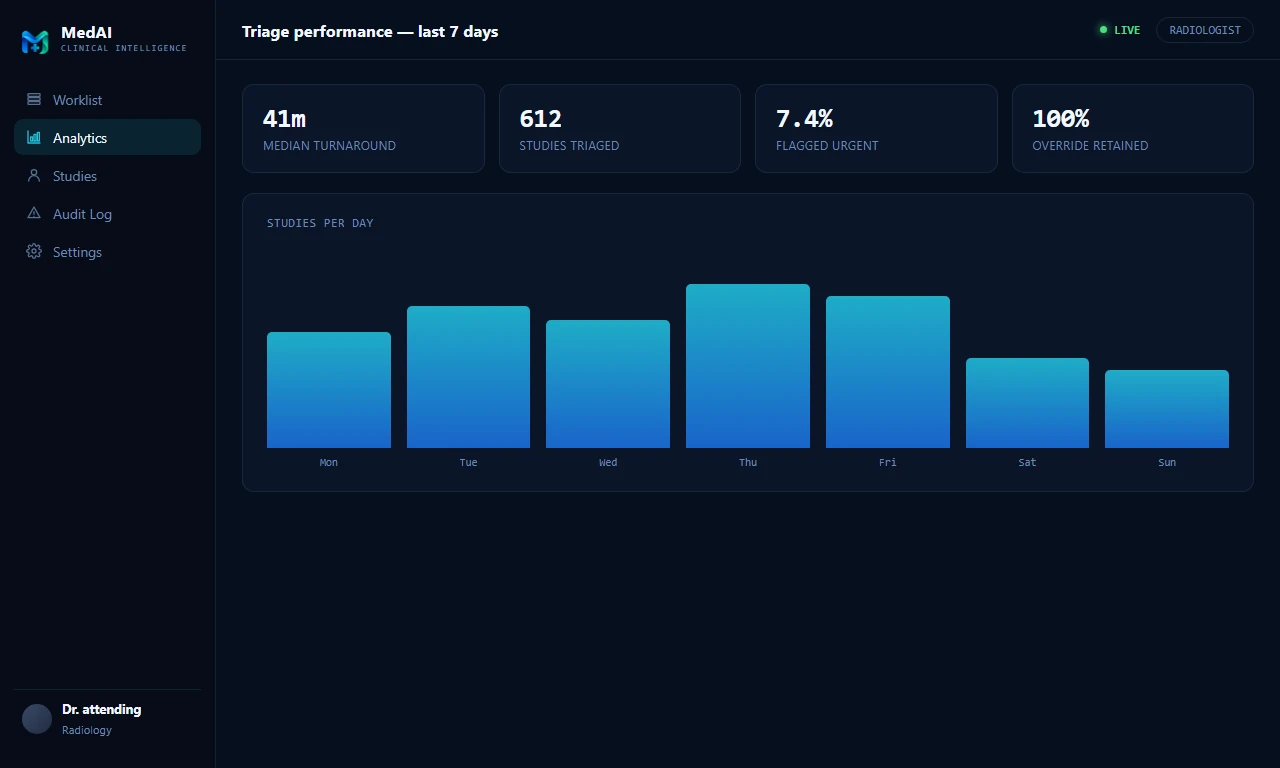
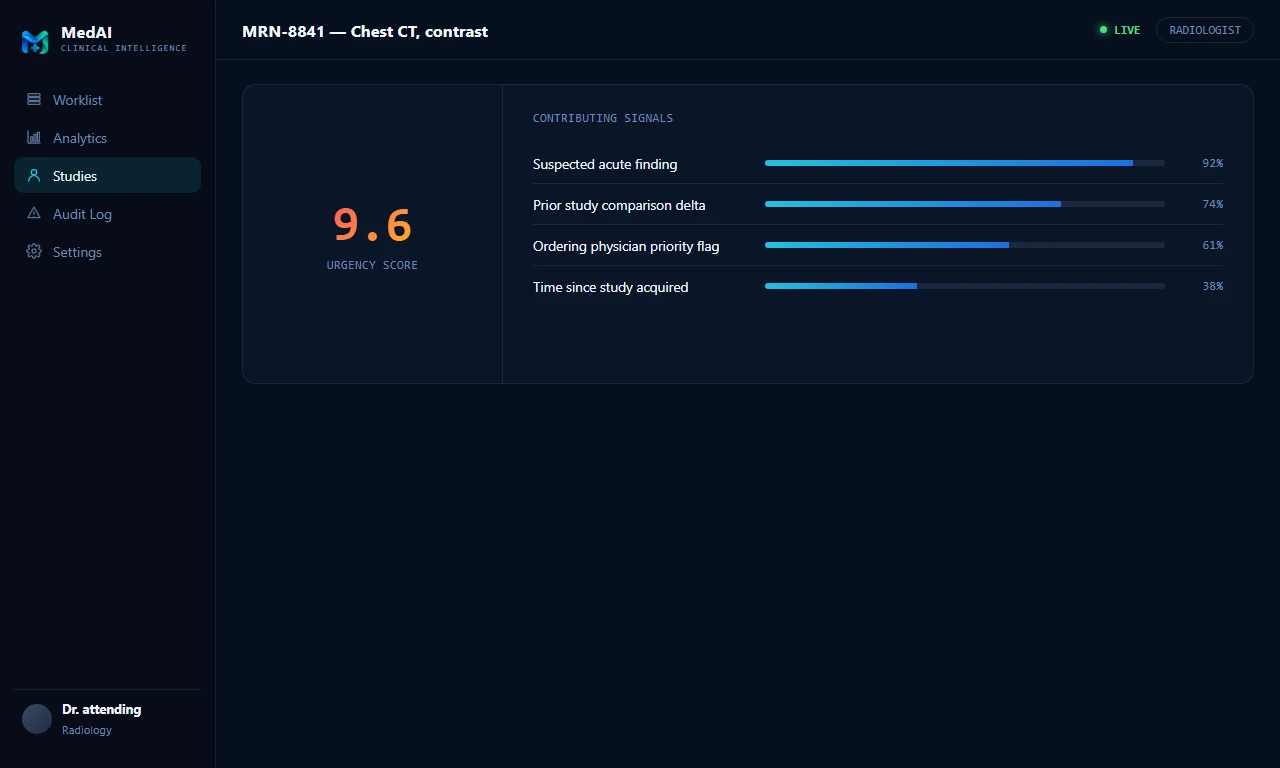
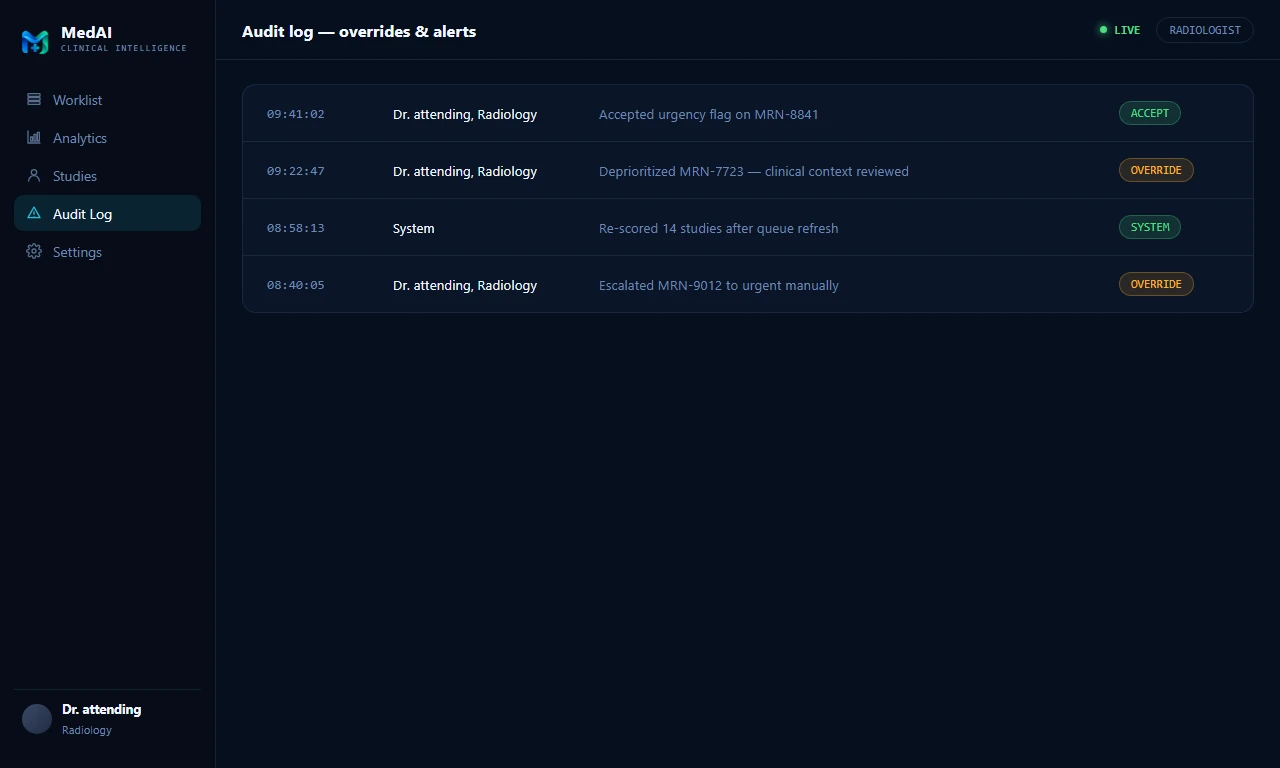
Median turnaround on urgent-flagged studies dropped from roughly a day to under an hour, a 58% reduction in chart review time for the highest-priority cases. Clinical staff retained full override control over every triage decision throughout.
Straight from the team running triage on this system every shift.
“We almost didn't bother piloting this — we'd seen imaging AI vendors before and it's usually a black-box score nobody on the floor trusts. This wasn't that. It sits inside the PACS we already use so there was no new tool to train anyone on and every flag comes with the actual reason not just a number. Studies that used to sit for hours now surface the moment they matter and our radiologists still have full override on every one. It's the first AI tool our clinical staff asked us to keep.”
 Amira KhalilClinical Operations Lead, Healthcare
No. Every urgency score is a prioritization signal, not a diagnosis — a radiologist reviews and can accept, deprioritize, or override any flag before it affects the read order.
The triage layer runs inside your existing PACS environment and processes studies under the same access controls and data-residency rules already governing that system — no data leaves your clinical network to a third party.
12 weeks from kickoff to production for Meridian Health, covering the scoring model, PACS integration, and clinician rollout — not just a proof of concept.
A wrong score costs a clinician a few seconds of re-reading a queue position — it never removes a study from review or auto-closes a case. Override activity is logged and reviewed to keep the model tuned.
No — it's PACS-native. Radiologists keep working in the same worklist interface they already use; the queue just arrives pre-sorted by urgency.
Tell us your challenge. We'll come back with a concrete, no-obligation plan and a live demo of what's possible for your team.
50+ enterprise clients across 6+ GCC countries
Reply within 1 business day · No obligation.