
Claims Automation with AI: A GCC Insurer's Playbook
Claims automation works best as a triage and document-processing layer, not a full straight-through pipeline. GCC insurers that automate document intake, damage assessment, and fraud flagging cut processing time on routine claims without removing an adjuster from anything that needs judgment. This guide covers what's safe to automate, where straight-through processing fails, how computer vision fits damage assessment, and how to scope a first pilot.
 By: Asad Siddiq
Claims processing is where insurance operations either scale or bottleneck. Manual document review, damage assessment, and fraud checks each add days to a process customers expect to move in hours. Intelligent automation targets exactly that gap. Not by removing the adjuster, but by clearing everything routine off their desk first.
What Parts of the Claims Pipeline Are Safe to Automate?
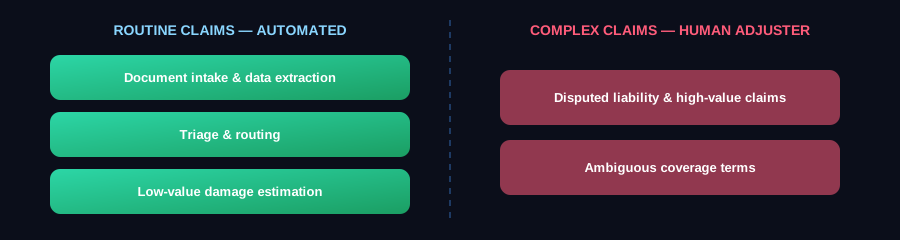
- Document intake and data extraction: pulling policy numbers, dates, and claimed amounts from submitted forms and photos.
- Initial triage and routing, sorting claims by complexity and urgency before a human ever opens the file.
- Damage estimation from photos on straightforward, low-value claims using computer vision.
- Fraud-pattern flagging. Surfacing claims with anomaly signals for adjuster review, not automatic denial.
Document Intake: The Highest-Volume, Lowest-Risk Starting Point
Every claim starts with paperwork: a claim form, supporting photos, sometimes a police report. Extracting structured data from that intake is mechanical, high-volume, and low-judgment, which is exactly why it's the safest and usually fastest-ROI automation target for a first pilot.
Triage and Routing Before a Human Opens the File
Once intake data is extracted, claims can be automatically sorted by complexity and urgency, routing the straightforward auto-damage claim to a fast lane and the disputed-liability claim to a senior adjuster, before either sits in a shared queue waiting to be picked up manually.
Where Does Straight-Through Automation Actually Fail?
High-value claims, disputed liability, and anything with ambiguous coverage terms still need a human adjuster's judgment. The mistake we see most is insurers trying to fully automate the whole pipeline in one move. The actual ROI shows up faster when automation is scoped narrowly to the routine, high-volume slice first.
Why Full Straight-Through Processing Is a Trap for Most Insurers
Straight-through processing, claim in, payout out, zero human touch, sounds like the end goal, but chasing it across the entire claims book usually means either automating disputed and high-value claims (dangerous) or narrowing the definition of 'automatable' so far that the ROI shrinks to nothing. The insurers who see real returns scope narrow and expand deliberately, not the other way around.
How Does Computer Vision Fit Into Claims Assessment?
For vehicle and property damage claims, computer vision can estimate repair cost ranges from submitted photos, flagging claims that fall outside expected damage patterns for closer review. It speeds up the routine cases and, just as importantly, flags the ones that need a human adjuster's eye before payout.
What Damage Assessment Models Actually Look For
The model compares submitted photos against a training set of prior claims with known repair costs, estimating a likely range based on visual damage patterns, dent size and location, panel involvement, glass damage. It's a range estimate, not a final number, and every estimate should carry a confidence score that determines whether it's auto-approved or routed for review.

Handling Photos That Don't Fit the Pattern
Unusual damage combinations, poor photo quality, or damage that doesn't match typical patterns should automatically route to a human adjuster rather than force a low-confidence estimate through. This is the same discipline as any anomaly-aware system: know what you don't know, and hand it off instead of guessing.
The claims that should move fast are the ones automation should touch first. Everything else stays with a human by design.
What Regulatory Considerations Apply to Claims Automation in the GCC?
Insurance is one of the most regulated industries in the GCC, and any automated decision affecting a payout needs to hold up to regulatory scrutiny, not just internal review.
Keeping a Human Accountable for Every Automated Decision
Regulators generally expect a named, accountable human decision-maker behind any claim outcome, even one substantially assisted by automation. That means the system should support and speed up an adjuster's decision, with a clear audit trail of what the automation recommended and what the human ultimately decided. Not replace the decision-maker outright.
Data Residency and Customer Data Handling
Claims documents and photos often contain sensitive personal and financial information. Any automation pipeline needs to meet the same data residency and handling requirements your existing claims systems already comply with; automation doesn't get a compliance exemption because it's new.
How Should a GCC Insurer Start?
Scope one claim category, auto damage or straightforward property claims are the usual starting point, and measure processing time before and after.
Choosing the Right First Category
The best starting category has three traits: high volume (enough claims to measure a real signal), low average complexity (most claims in the category resolve the same predictable way), and existing photo or document evidence (nothing new to collect). Auto damage and straightforward property claims usually hit all three for a GCC insurer's book.
Talk to us about which slice of your claims volume gives the fastest, most measurable win before expanding automation further.
What Does a First Pilot Look Like Week by Week?
A concrete timeline makes the scoping advice above actionable rather than abstract.
Weeks 1-2: Category Selection and Baseline Measurement
The team selects the target claim category, pulls historical processing-time data as a baseline, and confirms the document and photo evidence typically available for that category is consistent enough to automate against.
Weeks 3-6: Parallel Run Alongside Existing Process
Automated intake, triage, and (where applicable) damage estimation run alongside the existing manual process without replacing it yet, adjusters see both the automated output and continue their normal review, so accuracy gets validated against real outcomes before anything goes live unsupervised.
Weeks 7+: Phased Handoff on Validated Categories
Once the parallel run confirms accuracy holds, the automated path takes over for the validated slice of claims, with adjusters shifting to review-by-exception rather than reviewing every single claim in that category from scratch.
What Should an Insurer Expect From the Customer Side?
Faster claims processing changes the customer experience as much as it changes internal operations, and it's worth preparing for both sides of that shift.
Setting Accurate Expectations on Turnaround Time
Once a claim category is automated, customer-facing turnaround-time communications should update to reflect the new reality. A straightforward auto-damage claim that used to take days can often resolve in hours. Under-promising after the automation is live undersells a real improvement customers will notice regardless.
Keeping a Clear Escalation Path Visible to Customers
Customers with a claim that falls outside the automated category, or who simply want to speak to a person, need an obvious, fast path to a human adjuster. A faster automated path that makes escalation harder to find creates more frustration than the automation saves.
How Does Claims Automation Affect the Adjuster Role Long-Term?
Automation doesn't eliminate the adjuster role; it changes what the role spends its time on, and insurers planning a rollout should plan for that shift explicitly, not treat it as a side effect.
From Volume Processing to Complex-Case Specialization
As routine claims move through the automated path, adjusters spend proportionally more time on complex, disputed, or high-value claims, the cases that were always the highest-skill part of the job. Insurers that plan for this shift see it as a career-development opportunity for adjusters; insurers that don't risk it reading as a threat to job security instead.
Communicating the Shift Internally Before Rollout
Adjusters who hear about automation plans secondhand, or only once a pilot is already live, tend to see it as a threat by default. Insurers that get ahead of that by framing the change clearly, what moves to automation, what stays human, and how the adjuster role evolves, see far smoother internal adoption than those who don't.
Retraining Budgets Are Part of the Real Cost
Adjusters shifting into complex-case specialization often need training they didn't previously require day-to-day. Deeper fraud-pattern investigation, liability disputes, high-value claim negotiation. Budgeting for that retraining alongside the technology spend is what makes the long-term transition actually work, rather than leaving experienced staff underprepared for their new focus.
Frequently asked questions
Can AI fully automate insurance claims processing?
Only for a narrow slice of routine, low-value claims. High-value claims, disputed liability, and ambiguous coverage terms still need a human adjuster's judgment.
How does AI speed up claims document processing?
It automates data extraction from submitted forms and photos, pulling policy numbers, dates, and claimed amounts, so a human doesn't have to manually enter that data before review can start.
Can computer vision estimate vehicle damage from photos?
Yes, for straightforward damage patterns it can estimate a repair cost range from submitted photos, while flagging damage that falls outside expected patterns for a human adjuster to review.
Does claims automation increase fraud risk?
Done correctly, it reduces fraud risk by surfacing anomaly patterns for adjuster review, it should flag suspicious claims, not auto-approve or auto-deny them.
Which claim types should a GCC insurer automate first?
Start with the highest-volume, lowest-complexity category, typically auto damage or straightforward property claims, where the time savings are fastest to measure.
Want this built for your team?
We ship production-grade AI like this across every industry, in weeks, not months.