
Sovereign AI & Data Residency in the UAE: What Enterprises Need to Know in 2026
Sovereign AI means the model, its data, and the infrastructure it runs on all stay under one jurisdiction's law. It is not enough for data to sit inside a country. The law of that country has to control it at every step, a distinction that matters most for enterprises weighing local LLM deployment against cloud APIs. The UAE's PDPL does not force blanket data localization. But sector rules from the Central Bank and the Health Data Law require in-country residency for most of what enterprises process. In 2026, the Core42 sovereign financial cloud and the new federal AI and Data Authority raised the stakes further. This guide covers what sovereign AI requires in practice, which sectors are affected, and how to architect around it without stalling deployment.
 By: Asad Siddiq
What Is the Difference Between Data Residency and Data Sovereignty?

Data residency is a physical fact: your data sits on servers inside a specific country's borders. Data sovereignty is a legal fact instead. It asks which jurisdiction's laws apply to that data. Those laws apply wherever the data is processed, not just where it is stored. This distinction matters more for AI than for traditional software, because inference itself is processing. Say a UAE enterprise sends a customer record to a foreign-hosted LLM API for a single completion. That record has briefly left UAE legal control. It left even if it is deleted right after and the storage layer never leaves the country. Under the PDPL, cross-border transfers are not banned outright. But they need an adequacy finding or contractual safeguards equal to PDPL protections. Most enterprises skip that assessment. They wire up a third-party API key instead of running a reviewed data processing agreement.
Which UAE Sectors Face Mandatory In-Country AI Data Rules?
The PDPL sets a general baseline. But financial services, healthcare and government are the sectors with real enforcement teeth. Banks and licensed financial institutions fall under the Central Bank of the UAE's Guidelines for Financial Institutions Adopting Enabling Technologies. These guidelines cover cloud computing, AI and biometrics. They require institutions to prove they keep full audit, access and exit rights over any cloud or AI vendor. Healthcare providers face parallel obligations under the UAE's Health Data Law. Government entities and their vendors sit in the strictest tier by default. Most government RFPs now list in-country hosting as a hard requirement, not a preference. This site's earlier piece on government automation documents the same pattern on the delivery side.
- Banking & finance: CBUAE enabling-technology guidelines, full audit/exit rights over cloud and AI vendors.
- Healthcare: UAE Health Data Law, patient records treated as a restricted data class.
- Government & public sector: in-country hosting usually mandatory at RFP stage, not negotiable post-award.
- Everything else (retail, logistics, professional services): PDPL baseline applies, cross-border transfer allowed with adequacy or contractual safeguards.
What Does a CBUAE Audit Actually Check for AI Vendors?
A CBUAE examination on an AI vendor relationship does not stop at which cloud region hosts the model. It asks for three specific artifacts: a signed data processing agreement naming the vendor's subcontractors, a tested exit plan that proves the bank can migrate away without service disruption, and a log showing who accessed customer data and when. Banks that can produce all three during a review clear this check quickly. Banks that only have a general vendor terms-of-service agreement do not.
What Does the Health Data Law Restrict for AI Systems?
The UAE Health Data Law treats patient records as a restricted class regardless of whether an AI system is reading them for diagnosis support or simply indexing them for a hospital's internal search tool. Both count as processing. A hospital building a clinical AI assistant needs the same in-country hosting and access controls whether the assistant answers ten queries a day or ten thousand. Scale does not loosen the requirement, and treating a low-traffic pilot as exempt from full review is a common early misstep.
What Changed in 2026: Sovereign Cloud and the AI & Data Authority
Two 2026 developments raised the bar rather than lowering it. First, the Central Bank of the UAE and Core42 announced a sovereign financial cloud built for regulated financial workloads. It gives banks a nationally aligned alternative to hyperscaler public cloud for the first time. Second, the UAE Cabinet approved a federal Artificial Intelligence and Data Authority. It consolidates AI, data and digital-government functions that were previously split across multiple bodies. Neither change makes AI adoption optional to delay. Both signal that regulators expect enterprises to have already mapped where their AI workloads run and under whose law. The global sovereign AI infrastructure market is now estimated in the tens of billions of dollars for 2026. Double-digit annual growth is projected through the next decade, a scale that reflects how many governments are making the same call the UAE has.
How Should Enterprises Architect AI Deployments Around Data Residency?
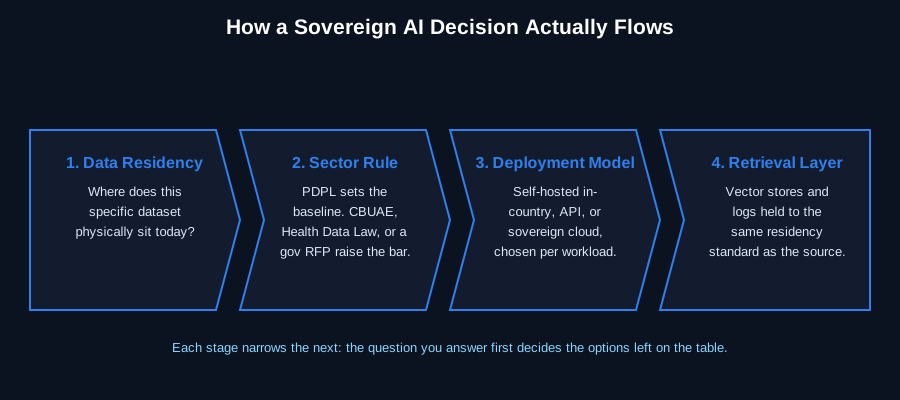
In practice, this comes down to three architectural decisions made before a single model is deployed, not retrofitted afterward. First, classify the data. Personal, financial, health and government-sourced data get the strictest treatment. Aggregated or synthetic data has far more flexibility. Second, choose the deployment model deliberately. Our guide to local LLM deployment in the GCC walks through when self-hosting an open-weight model in-country beats an API call, and when it doesn't. Third, build the retrieval layer, not just the model, on infrastructure you control. A RAG system that indexes regulated documents needs its vector store, embeddings and logs held to the same residency standard as the source data. Teams miss that detail when compliance review focuses only on the model provider.
A Practical Sequence for a Compliance-Ready Deployment
- Classify every data source the AI system will touch, not just the primary dataset, by residency requirement.
- Confirm whether your sector regulator (CBUAE, Health Data Law, or a government RFP) sets a stricter bar than PDPL's general baseline.
- Decide self-hosted-in-country vs. API vs. sovereign cloud per workload, not as a single company-wide policy.
- Extend residency review to the retrieval layer (vector stores, logs, embeddings), not only the model endpoint.
- Document the decision and the cross-border safeguard (if any) before go-live, not after a regulator asks.
None of this needs to slow a deployment down by months. It needs to happen in the architecture phase, alongside model selection. It should not be a legal review bolted on after a pilot already proved the use case. Enterprises that treat data residency as a design constraint from day one ship faster overall. They are not re-architecting a production system to satisfy an objection a compliance team raises during procurement.
What Happens When a Company Gets This Wrong?
The realistic failure pattern rarely looks like a dramatic data breach. It looks like a compliance team discovering, months into a live deployment, that a RAG system's vector database sits on a cloud region outside the UAE because a developer left the provider's default region in place. Fixing that after launch means migrating a live index, re-running compliance sign-off, and explaining the gap to a regulator who asks why it was not caught earlier. None of that is technically difficult. All of it is expensive and slow compared to specifying the region at setup, which costs nothing extra.
- A delayed CBUAE or Health Data Law examination response while the gap gets fixed.
- Migration cost for a live vector index or model endpoint, higher than specifying the region at setup would have been.
- Reduced regulator trust heading into the next license renewal or audit cycle.
Does Sovereign AI Mean You Must Self-Host Every Model?

No, and this is the most common misreading of the term. Sovereign AI is about legal control over data and processing. It is not about rejecting every third-party or cloud-hosted model outright. A UAE enterprise can use a cloud API provider and still satisfy sovereignty requirements. That works if the provider offers an in-country region and contractual data-processing guarantees consistent with PDPL, and the enterprise has verified those guarantees rather than assumed them from a general terms-of-service page. Self-hosting, covered in our local LLM deployment guide, is one path to sovereignty. It is usually the right one for the strictest data classes: government and health records, high-risk financial data. But it is not the only path. Treating it as mandatory across every workload adds infrastructure cost and operational burden to data that never needed that level of control.
What Should an Enterprise Do in the Next 90 Days?
Given the direction of 2026's regulatory moves, waiting for a final, settled rulebook before acting is the wrong call. The practical next step for most enterprises is a data classification exercise. Map which systems touch personal, financial, health or government data. Cross-reference that against which of those systems are candidates for AI deployment in the next year. That map turns an abstract compliance question into a short, prioritized list. Only those workloads need a residency decision made deliberately. Everything else can proceed on the PDPL baseline without further review.
Consider a retail enterprise piloting a customer service AI copilot. Most of what it processes, product catalogs, generic support scripts, falls under the PDPL baseline with no special residency review needed. But if that same copilot ever touches loyalty-program payment data, it crosses into CBUAE territory the moment a transaction record enters the prompt. The classification exercise catches that boundary before the pilot ships, not after a compliance reviewer asks why payment data appears in a chatbot's context window.
Frequently asked questions
What is sovereign AI in the UAE context?
Sovereign AI means the AI model, the data it processes, and the infrastructure it runs on all remain under UAE legal jurisdiction throughout the entire lifecycle, not just at rest in storage, but during training and inference too.
Does UAE law require all company data to stay inside the UAE?
No. The PDPL allows cross-border data transfer with adequacy findings or contractual safeguards. But sector regulators, especially CBUAE for financial data and the Health Data Law for healthcare, impose stricter in-country requirements that override the general baseline.
Do RAG and knowledge-retrieval systems need special data residency review?
Yes. The vector store, embeddings and query logs a RAG system generates from regulated documents need the same residency treatment as the source data itself, a step compliance reviews often miss when they focus only on the model endpoint.
Does building for data residency slow down an AI deployment?
Not if it's handled during architecture. Classifying data and choosing the deployment model per workload up front is faster overall than re-architecting a production system after a compliance objection during procurement.
What does the new federal AI & Data Authority change for data residency decisions?
It consolidates AI, data and digital-government oversight that used to sit across separate bodies, so enterprises should expect coordinated guidance and audits rather than conflicting requirements from different agencies. It does not replace or loosen the existing PDPL, CBUAE, or Health Data Law obligations.
Should a UAE enterprise wait for final sovereign AI regulations before deploying?
No. The direction of 2026's regulatory moves, the sovereign financial cloud and the federal AI & Data Authority, points toward tighter expectations, not looser ones. A data classification exercise done now costs far less than retrofitting compliance into a system already in production.
Want this built for your team?
We ship production-grade AI like this across every industry, in weeks, not months.