
AI-Driven E-Invoicing Compliance for UAE Businesses: A Practical Guide
UAE businesses searching for ai-driven e-invoice compliance platform are usually reacting to one of two triggers. Either their finance team just read the Ministry of Finance's phased e-invoicing timeline, or they already tried building a manual reconciliation process on top of it and watched it strain under invoice volume. The two problems compound. Manual compliance workflows that hold up fine at 200 invoices a month start missing errors at 2,000, right as the mandate turns every invoice into a reportable regulatory record. The UAE Ministry of Finance has confirmed a phased e-invoicing rollout: voluntary adoption starting July 2026, phasing into mandatory use for large taxpayers from 2027. This guide covers what the mandate actually requires, why AI-based validation closes gaps a basic invoicing tool cannot, and how to prepare before the deadline that applies to your business arrives.
 By: Asad Siddiq
What Is the UAE's Mandatory E-Invoicing Rollout?

The UAE Ministry of Finance set out its Electronic Invoicing System through Ministerial Decisions No. 243 and No. 244 of 2025, with the Electronic Invoicing Guidelines detailing a phased rollout rather than a single cutover date. Voluntary adoption opens on 1 July 2026. A pilot programme for the UAE's top 100 taxpayers begins in August 2026. Mandatory use then takes effect from 1 January 2027 for businesses with annual revenue of AED 50 million or more, with other large taxpayers expected to follow from February 2027. The mandate currently covers business-to-business and business-to-government transactions. Business-to-consumer invoicing stays out of scope for now.
Which Businesses Are In Scope First?
Scale determines your deadline, not industry. The largest 100 taxpayers face the earliest real test through the August 2026 pilot. Every business clearing AED 50 million in annual revenue becomes mandatory from January 2027. If your revenue sits below that line today, the rollout still matters: enforcement dates for smaller taxpayers typically follow once the largest cohort proves the system works, and building compliant invoicing habits before a deadline forces the issue costs far less than retrofitting them under pressure.
What Is an Accredited Service Provider and Why Does It Matter?
Every invoice under the mandate has to move through an Accredited Service Provider (ASP) approved by the Ministry of Finance, rather than passing directly between buyer and seller. In its May 2026 accreditation guidance, the Ministry confirmed that an ASP applicant must already be an active Peppol-certified service provider and meet company registration, tax registration, and information security requirements. In practice, this means your invoicing system needs to speak Peppol's data exchange standard and route every transaction through a certified intermediary. Choosing an ASP is not a formality. It is the pipe every compliant invoice has to pass through, and switching providers later means re-testing that pipe end to end. This is also why the decision belongs to finance and IT together. Finance owns the deadline and the tax exposure. IT owns whatever integration work connects the ERP to the ASP's API, and that work is easier to scope correctly the earlier both teams sit in the same conversation.
How Does E-Invoicing Fit Into the UAE's Broader Tax Digitization Push?
E-invoicing is not an isolated requirement. It follows the same direction the UAE has taken with VAT since 2018 and corporate tax since 2023: move tax administration from periodic filings toward continuous, system-verified reporting. Once invoice data reaches the FTA through the ASP network in near real time, discrepancies between what a business reports and what its invoices actually show become far easier to spot. That shift changes the cost of a sloppy invoicing process. A TRN typo or a missed duplicate used to surface, if at all, during an annual VAT reconciliation. Under the new system, the same error is visible at the transaction level as soon as it happens.
Why Are UAE Businesses Turning to AI for E-Invoicing Compliance?
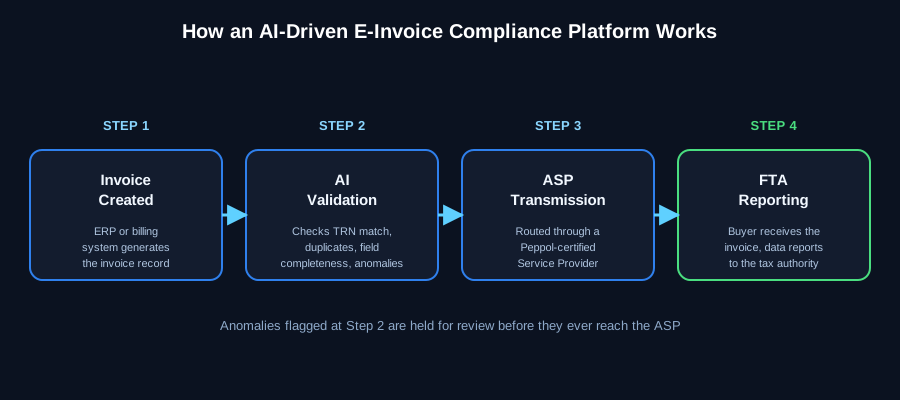
Manual reconciliation does not scale against a mandate that scores every single invoice. A finance team checking a sample of invoices each week can catch obvious errors, but it cannot verify tax registration numbers, invoice formatting, and duplicate submissions across thousands of records in real time. This is where an ai-driven e-invoice compliance platform earns its cost. Instead of routing every invoice through a manual queue before it reaches the ASP, the platform validates format, tax fields, and buyer and seller registration data automatically, flags anomalies before submission, and keeps an audit trail the FTA can query directly. Adoption is rising for a simple reason: ai-powered e-invoice compliance turns a once-a-week spot check into a check that runs on every transaction, at the moment it is created.
How Does an AI-Driven Platform Differ From Basic Invoicing Software?
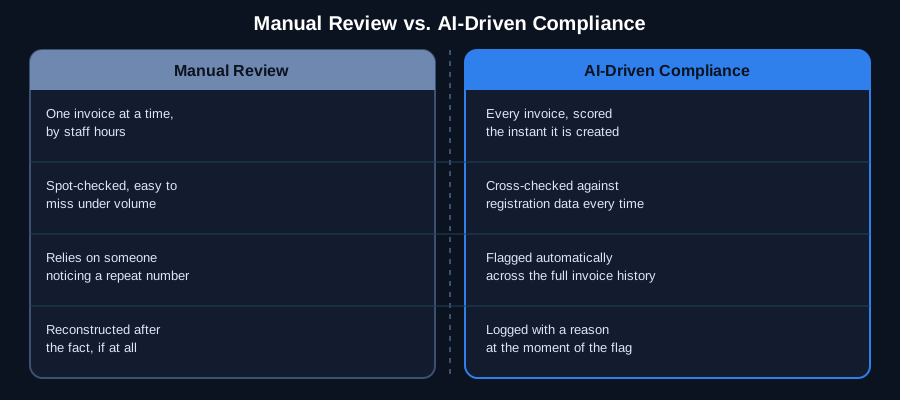
Standard invoicing software checks that required fields are filled in and formatted correctly. It has no view into whether a tax registration number actually matches the counterparty on file, whether an invoice number has already been used this quarter, or whether a transaction amount is a statistical outlier against that vendor's normal pattern. Ai compliance software built for this problem adds that layer. It cross-references registration data, scans invoice history for duplicates, and scores unusual amounts or timing before the invoice is transmitted, catching the errors that would otherwise surface for the first time during an FTA audit. This layered validation is the same principle behind AI-based document review in contract compliance work: a rules check confirms structure, and a model check confirms substance.
What Data Signals Does an AI Compliance Layer Actually Check?
The value is in what gets scored, not just that scoring happens. A working model checks the tax registration number against the counterparty's official record, confirms the invoice number has not appeared before across any connected system, and compares the transaction amount and timing against that vendor's typical pattern. It also verifies that the line-item tax treatment is internally consistent, so a mixed-rate invoice does not slip through with one line taxed incorrectly. None of these checks are exotic. They are exactly what a careful human reviewer would do given unlimited time, run instead in the seconds between invoice creation and ASP transmission.
What Compliance Risks Does Manual Review Miss?
- Duplicate invoice numbers reissued across systems that a manual spot-check has no way to catch at scale.
- TRN mismatches between the invoice and the counterparty's registration record, which surface only when someone cross-references both manually.
- Late or missing transmission to the ASP on high-volume days, when queue backlogs push submissions past the reporting window.
- Inconsistent tax treatment across similar transactions handled by different staff, with no single system flagging the drift.
How Should a UAE Business Prepare for the 2026-2027 E-Invoicing Deadlines?
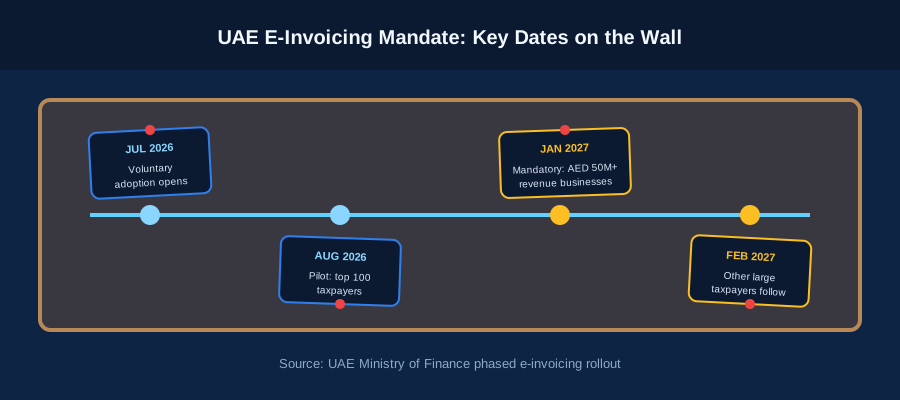
Start now if your revenue is at or approaching AED 50 million. Your mandatory deadline is January 2027, and choosing an ASP, testing Peppol connectivity, and validating your data quality all take longer than most finance teams expect on the first attempt. You have more runway if you are well under that threshold, but voluntary adoption from July 2026 is still worth testing early, since the same infrastructure will eventually apply to you regardless of the exact date it becomes mandatory. Waiting until the deadline is confirmed for your bracket means competing with every other business in the same position for the same pool of ASP onboarding slots and integration consultants.
What Should Finance Teams Do in the Next 90 Days?
- Confirm which revenue bracket your business falls into and map it against the January 2027 and February 2027 dates.
- Shortlist Peppol-certified Accredited Service Providers and confirm they support your existing ERP or billing system.
- Audit a sample of recent invoices for TRN accuracy and duplicate numbering to see how much manual error already exists.
- Decide whether AI-based validation runs as a layer on top of your ASP connection or gets built into the ERP integration itself.
Should You Build In-House Tooling or Use an AI Compliance Platform?
Building in-house makes sense only if invoicing volume and internal engineering capacity both justify it, and few mid-market UAE businesses clear that bar. An AI compliance layer that plugs into your existing ERP and ASP connection gets validation running in weeks rather than the months a custom build takes, and it comes with a model that improves as it sees more invoice patterns instead of a rule set that needs manual updates every time a new error type shows up.
What About Multinational Groups With UAE Subsidiaries?
A regional headquarters with UAE subsidiaries has to treat this as a local compliance project, not a global template exercise. Peppol connectivity and ASP accreditation are UAE-specific requirements, so a group-wide invoicing platform used across other markets still needs a UAE-compliant routing layer bolted on, tested against the local guidelines rather than assumed to work because it handles e-invoicing elsewhere. Group finance teams that centralize invoicing out of a shared services center should confirm early, directly with their ASP and tax advisor, which UAE-registered entity's revenue is what actually triggers the deadline, rather than assuming the parent group's global revenue is what counts.
Frequently asked questions
When does e-invoicing become mandatory in the UAE?
Voluntary adoption opens 1 July 2026. A pilot for the UAE's top 100 taxpayers starts in August 2026. Mandatory use begins 1 January 2027 for businesses with AED 50 million or more in annual revenue, with other large taxpayers expected to follow from February 2027, per the Ministry of Finance's phased rollout.
Does the UAE e-invoicing mandate apply to business-to-consumer transactions?
Not currently. The mandate covers business-to-business (B2B) and business-to-government (B2G) transactions. B2C invoicing is out of scope for now under the published guidelines.
What is an Accredited Service Provider and do I need one?
An Accredited Service Provider (ASP) is a Peppol-certified intermediary approved by the Ministry of Finance that every e-invoice must route through. Any business in scope of the mandate needs an ASP connection; it cannot transmit compliant invoices directly to a buyer or the tax authority without one.
Can AI actually reduce e-invoicing compliance errors compared to manual review?
Yes. An AI-driven e-invoice compliance platform checks every invoice against tax registration data, duplicate history, and formatting rules the instant it is created, catching mismatches and anomalies that a manual spot-check across full invoice volume is structurally unable to find.
Which entity's revenue determines a multinational group's UAE e-invoicing deadline?
This should be confirmed directly with your ASP and tax advisor rather than assumed. Groups running invoicing through a shared services center often centralize the process across entities, but the deadline is a compliance question tied to how the UAE-registered entity is classified, not automatically the parent group's global revenue.
Want this built for your team?
We ship production-grade AI like this across every industry, in weeks, not months.