
What AI-first engineering actually means in 2026
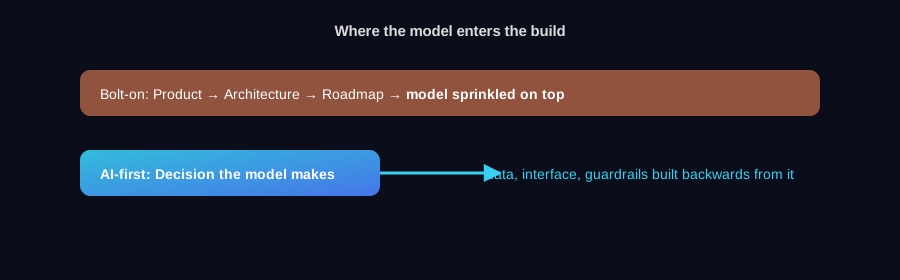
Every company now claims to be AI-first. Very few actually are. The difference isn't how many models you ship. It's whether the model shapes the product, the architecture, and the roadmap, or whether it's bolted on at the end.
 By: Asad Siddiq
For most of the last decade, software teams designed a system and then, if there was budget left, sprinkled some machine learning on top. AI-first inverts that order. You start from the decision the model needs to make, then build the data pipeline, the interface, and the guardrails backwards from that decision.
What Questions Separate Real AI-First Teams From the Rest?
When we scope a project, we ask three questions before writing a line of code. The answers tell us instantly whether a team is genuinely AI-first or just following the trend.
- What decision does the model make, and what does a wrong answer cost? If nobody can name the decision, there is no product.
- Where does the ground-truth data come from, and how does it stay fresh? A model is only as good as the data pipeline feeding it.
- How does a human override the model, and how is that override captured? Overrides are the highest-signal training data you will ever get.
Why Design Around Uncertainty Instead of Accuracy?
Traditional software is deterministic: the same input gives the same output. Models are probabilistic. AI-first products are built to be graceful when the model is unsure. They degrade to a safe default, ask for confirmation, or route to a human. Teams that treat 92% accuracy as 'done' ship products that fail loudly on the other 8%.
The goal isn't a perfect model. It's a product that stays useful, and trustworthy, even when the model is wrong.
How Do You Tell Hype From Real Leverage?
The stakes for getting this right are real: Gartner projects at least 30% of generative AI projects will be abandoned after proof of concept, largely from unclear business value and poor data quality, the same issues an AI-first architecture is built to prevent.
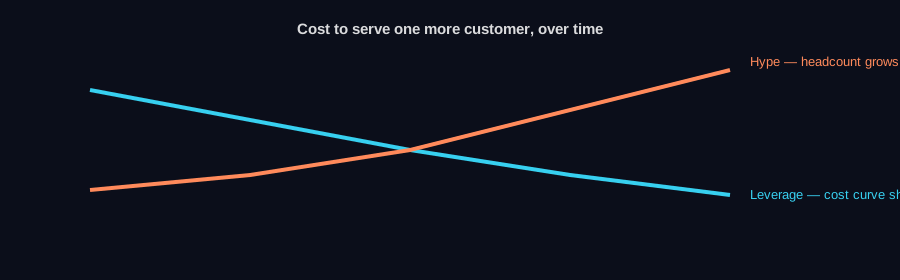
Real leverage shows up as a shrinking cost curve: each new customer or document or transaction costs less to serve than the last, because the model absorbs the work. Hype shows up as a growing headcount of people cleaning up after the model. If your AI feature needs more humans every month to stay accurate, it isn't leverage. It's a liability with a nicer demo.
How Should a UAE Enterprise Start an AI-First Initiative?
Start with the highest-cost decision your team makes today, the one where a wrong call is expensive and a right one compounds. Scope a single AI consulting engagement around naming that decision, the data behind it, and the override path, before any model gets chosen. This is the pattern we see most often in IT and tech teams moving fast: teams that start narrow and prove leverage on one decision earn the budget to go AI-first everywhere else. Once that first decision is live, MLOps discipline is what keeps it honest instead of quietly drifting wrong.
Frequently asked questions
What does "AI-first" actually mean, in practice?
AI-first means the model shapes the product, architecture, and roadmap from day one, not that a model gets added after the product is already built. The core test: can the team name the exact decision the model makes and what a wrong answer costs?
How is AI-first different from just using more AI features?
Feature count doesn't tell you much. A product with one well-scoped model that shapes the core workflow is more AI-first than one with five bolted-on AI features that could be removed without changing what the product does.
Why design for uncertainty instead of just improving accuracy?
Models are probabilistic, not deterministic. There will always be a percentage of cases the model gets wrong. AI-first products degrade gracefully in those cases (safe default, ask for confirmation, route to a human) instead of failing loudly on the accuracy gap.
How do I tell if our AI investment is real leverage or just hype?
Track the cost to serve one more customer, document, or transaction over time. Leverage shows up as that cost shrinking as the model absorbs more of the work. Hype shows up as a growing headcount needed to keep the AI accurate. That's a liability, not leverage.
Where should a UAE enterprise start with AI-first design?
Start with the single highest-cost decision your team makes today, not a company-wide AI platform. Scope one engagement around naming that decision, the data feeding it, and the human-override path, before choosing a model.
Want this built for your team?
We ship production-grade AI like this across every industry, in weeks, not months.