
AI Governance Framework for UAE Enterprises: A Procurement Checklist
An AI governance framework is the set of owners, rules and records that decide who may buy, build and run AI in your organization, and how you prove it behaved. For a UAE buyer it works as a procurement filter: if a vendor cannot show these controls, you should not sign. This guide covers governance and vendor evidence. Where the data sits is a separate question, and our sovereign AI and data residency guide covers it. Here we map ISO/IEC 42001, the Central Bank of the UAE (CBUAE) guidance for banks and the PDPL onto one checklist you can hand to any vendor.
 By: Asad Siddiq
What Is an AI Governance Framework?
An AI governance framework is a written system of accountability for AI. It names who approves a use case, who owns each model, what testing is required before launch, and what records you keep afterward. It is not a policy document that sits in a drawer. It is a working process with owners, dates and evidence.
What Does a Framework Actually Contain?
Most working frameworks have five parts. Each one answers a question an auditor, a regulator or your own board will eventually ask.
- Accountability: a named executive owner for every AI system, plus a committee that can say no.
- Inventory: a live list of every model and AI-enabled tool in use, including those bought inside other software.
- Risk tiering: a simple rule that sorts use cases by impact, so a meeting summarizer gets lighter review than a credit decision.
- Lifecycle controls: required testing, approval and monitoring steps from idea to retirement.
- Evidence: logs, test results and sign-offs you can produce on request.
How Is Governance Different From Security or Compliance?
Security protects the system from attackers. Compliance proves you meet a specific law. Governance sits above both. It decides which AI you should run at all, who is responsible when it errs, and how you will know. A system can be secure and legal and still be badly governed, for example when nobody owns its accuracy after launch.
Which Standards and Rules Shape AI Governance for a UAE Enterprise?
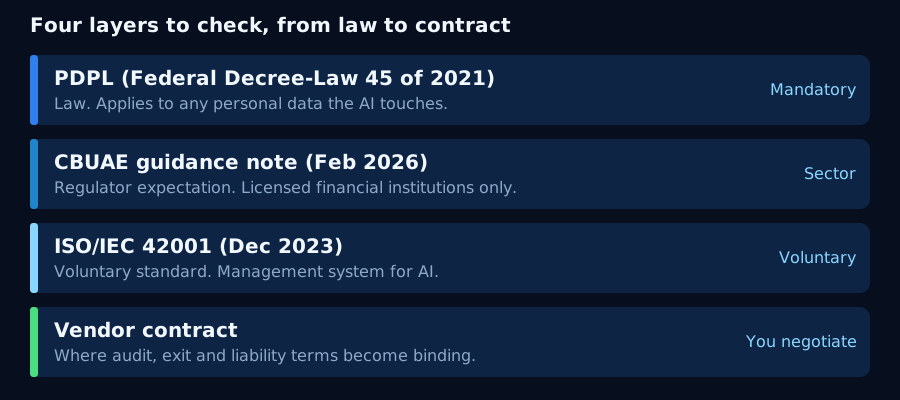
Three sources do most of the work: ISO/IEC 42001 as the management standard, CBUAE guidance if you are a licensed financial institution, and the PDPL for any personal data. They are different kinds of document. Treat them as layers, not alternatives.
What Is ISO/IEC 42001?
ISO/IEC 42001 is the first international management system standard for AI. It was published on 18 December 2023 as a first edition. It specifies requirements for "establishing, implementing, maintaining and continually improving an AI management system" inside an organization. It applies to companies that provide or use AI, at any size.
The standard follows the same shape as other ISO management systems: context, leadership, planning, support, operation, performance evaluation and improvement. It adds AI-specific items such as impact assessment and supplier oversight. A vendor can be certified by an accredited body. A buyer can also run its own governance in line with the standard without certifying.
One caution. Certification covers a defined scope. Ask which products, teams and sites sit inside it. A certificate for a vendor's internal operations does not prove the specific system you are buying is governed.
What Does CBUAE Expect From Banks Using AI?
In February 2026 the Central Bank of the UAE issued its Guidance Note on Consumer Protection and Responsible Adoption and Use of Artificial Intelligence, according to law firm Pinsent Masons. It applies to licensed financial institutions. It expects a documented AI governance framework proportionate to the institution's size, nature and complexity. The National's report adds that senior management and the board should be accountable for AI systems and outcomes.
The same summary says institutions should keep a comprehensive inventory of AI models and clear roles across risk, compliance, internal audit and IT. They remain fully accountable for AI outcomes even when a third party supplies the system. Customers should be able to ask for human review or an explanation of an AI-generated decision. Read the Central Bank's own text before relying on any summary, including this one.
For a bank buyer, the point is simple. You cannot outsource accountability. Your vendor contract and your vendor evidence must let you meet the duties above. Our AI transaction monitoring guide for UAE banks shows how this lands in one regulated use case.
What Does the PDPL Add?
The PDPL is Federal Decree-Law No. 45 of 2021 and came into force on 2 January 2022. The UAE government portal states that it applies to processing of personal data inside or outside the country, prohibits processing without consent except in listed cases, and sets rules for cross-border transfer. It also gives individuals rights to correct, restrict or stop processing. The UAE Data Office handles policy, standards and complaints.
DLA Piper's summary adds details that matter for AI. A data protection impact assessment is required before processing that uses technologies posing a high risk to privacy. Individuals can object to decisions made by automated processing in some cases. The law also leaves intact existing rules in the DIFC, ADGM, health and banking. The same summary noted that the executive regulations had not been published as of January 2025, so confirm the current position with counsel before you finalize contract language.
Is There a Voluntary Reference If We Are Not a Bank?
Yes. The NIST AI Risk Management Framework was released on 26 January 2023 and is intended for voluntary use. It is a free, widely used vocabulary for mapping and managing AI risk. Many UAE teams use it for the risk-tiering step and ISO/IEC 42001 for the management system around it.
Choose ISO/IEC 42001 certification if:
- Your customers or tenders ask for independent proof of AI governance.
- You sell AI-enabled products and need one answer for many buyers.
- You already run other ISO management systems and have audit habits in place.
Choose alignment without certification if:
- You are early in AI adoption and need working controls before a paid audit.
- Your main drivers are internal risk and a regulator's expectations, not tenders.
- You want to test the framework on two or three systems first.
How Do You Evaluate an AI Vendor? A Procurement Checklist
Use the checklist below with any AI vendor, including us. Ask for evidence, not assurances. A strong vendor answers with a document, a log sample or a contract clause. A weak vendor answers with a sentence.

Accountability and Ownership
- Who is the named accountable owner on the vendor side for this system, and who on yours?
- Does the vendor keep an inventory of the models, versions and third-party APIs inside the product?
- Is there a written risk-tier rule, and which tier does this system fall into?
- Can the vendor show an AI impact assessment for a comparable deployment, with client details removed?
Data and Privacy
- Which personal data does the system touch, and on what legal basis under the PDPL?
- Where are prompts, embeddings and logs stored, and who can read them?
- Is customer data used to train or tune any shared model? The answer should be a contract clause, not a promise.
- Who are the sub-processors, and will you get notice before one changes?
- Can the vendor support a data protection impact assessment with the facts you need?
Model Risk and Testing
- What accuracy, bias and robustness tests ran before launch, and can you see the results?
- How are hallucination and unsafe output measured for generative systems?
- Are Arabic and English tested separately, with dialect coverage stated?
- What triggers a retest: a new model version, new data, or a drift alert?
Contract, Audit and Exit
- Does the contract grant audit rights over the AI system and its logs?
- Can you suspend or switch off the system immediately if you must?
- Is there a tested exit plan, with data return and deletion proof?
- Who carries liability for an AI-caused error, and is it stated in writing?
- Does the vendor notify you of incidents and material model changes within a set time?
Choose a pilot with controls first if:
- The use case is new to your organization and the risk tier is unclear.
- Your governance committee has not yet approved a full rollout.
- You want evidence from your own data before committing to a multi-year contract.
Choose full procurement now if:
- The vendor has passed every item above with documents, not statements.
- The system is already inventoried and tiered in your register.
- Legal has signed the audit, exit and sub-processor clauses.
What Does an Auditable AI System Look Like?
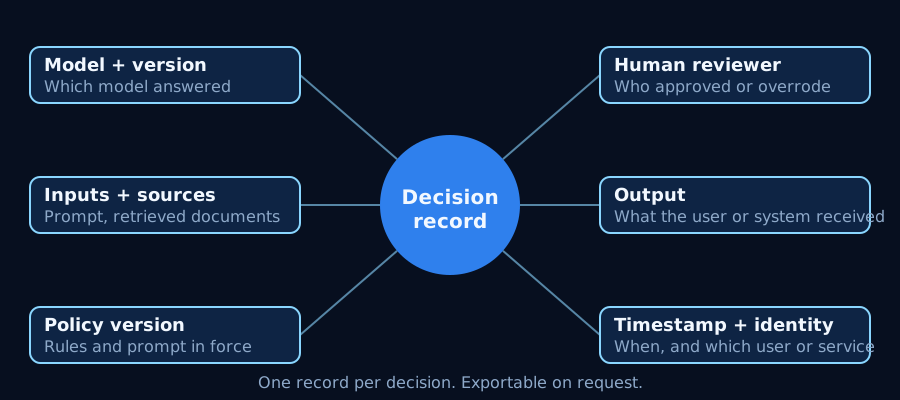
An auditable system lets a third party reconstruct any single decision after the fact. It records what went in, which model and rules ran, who or what approved the result, and what came out. If you cannot replay a decision, you cannot defend it to a regulator, a customer or a court.
What Goes Into a Decision Record?
Each decision should leave one record with six fields: the model and version, the inputs and retrieved sources, the prompt or policy version, any human reviewer, the output, and a timestamp with the user or system identity. For retrieval systems, store which documents were retrieved. That is what lets you check whether an answer was grounded.
How Should Human Oversight Work?
The CBUAE note, as summarized by Pinsent Masons, describes three oversight models: human in the loop, human on the loop and human out of the loop. The out-of-the-loop model is limited to low-risk processes. Pick the model by risk tier and write it down. A reviewer who approves every item in two seconds is not oversight. Track review time and override rates to see whether people are really checking.
How Do Monitoring and Change Control Keep It Auditable?
A decision record is only useful if the system stays stable and watched. Every model, prompt and data change should go through a ticket with an approver. Dashboards should track accuracy, drift and error rates against the thresholds you set at launch. Our guides on MLOps that keeps models honest and fraud detection you can explain show these controls in practice.
How Should You Run the Evaluation Process?
Run governance review in parallel with technical evaluation, not after it. Late reviews are where deals stall. A short, ordered process keeps both tracks moving.
What Is a Sensible Sequence?
- Register the use case and assign a risk tier.
- Send the checklist to two or three vendors with the same deadline.
- Score the evidence on a 0 to 2 scale per item: none, partial, documented.
- Run a time-boxed pilot with logging switched on from day one.
- Have legal, risk and the business owner sign the go decision in the register.
What Red Flags Should Stop a Deal?
- The vendor will not name sub-processors or the models behind the product.
- Audit rights are refused or limited to a questionnaire.
- Customer data may be used to train shared models, with no opt-out.
- No decision logs exist, or logs cannot be exported.
- The pitch rests on "trust us" or a certificate with an unclear scope.
Who Should Own Governance Inside Your Organization?
Give the framework a single executive owner, usually the chief risk officer, chief data officer or chief technology officer. Add a small cross-functional committee: legal, security, data, operations and the business sponsor. Meet monthly at first. The committee should approve new use cases, review incidents and sign off material changes. If you want help standing this up, a readiness review is a sensible first step.
Frequently asked questions
What is an AI governance framework?
It is the set of owners, rules and records that control how an organization approves, builds, buys and monitors AI. It covers accountability, a model inventory, risk tiers, testing and approval steps, and the logs you keep as evidence.
Is ISO/IEC 42001 mandatory in the UAE?
It is a voluntary international standard published in December 2023, not a law, so no statute makes it mandatory by itself. Buyers and tenders may still ask for it, so check the requirements of each procurement.
Does the PDPL apply to AI systems?
Yes, whenever an AI system processes personal data. The UAE government portal says the law covers processing inside or outside the country and requires consent except in listed cases. Check sector rules for banking and health, which the PDPL leaves in place.
Who is accountable if a vendor's AI makes a wrong decision at a bank?
The bank. CBUAE guidance, as summarized by Pinsent Masons, says licensed financial institutions remain fully accountable for AI outcomes even where a third party provides the system. Contracts should give the bank the audit rights and evidence it needs.
What is the single most useful thing to ask an AI vendor for?
A sample decision record. If the vendor can show what one logged decision contains (model version, inputs, policy version, reviewer, output, timestamp), most other governance questions become easier to answer.
Want this built for your team?
We ship production-grade AI like this across every industry, in weeks, not months.