
Best AI Company in Dubai: 10 Signals That Separate Delivery from a Pitch
The best AI company in Dubai for your project isn't the one with the slickest deck, it's the one that can show a live production system, name a real client contact, and explain exactly what happens when their model gets something wrong. This guide covers 10 concrete signals to check before you sign, not a ranked list of competitors, since the only honest way to evaluate a vendor is against your own use case, not someone else's marketing.
 By: Asad Siddiq
Dubai's AI market is crowded with vendors claiming enterprise-grade delivery, and a demo alone can't tell you which ones have actually shipped. These 10 signals are what to check directly, in the sales process, before a contract, not what a vendor's landing page claims about itself.
What Separates the Best AI Companies in Dubai from a Good Pitch?
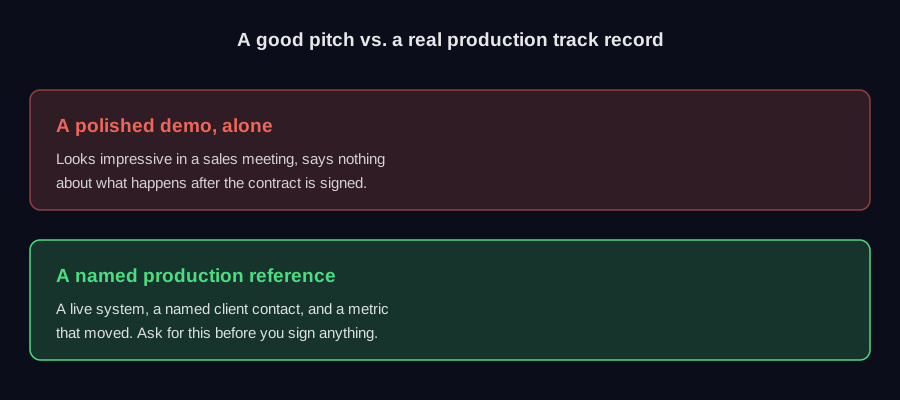
A good pitch demonstrates the product. A real production track record demonstrates what happens after launch: uptime under real load, a support response when something breaks, and a metric that moved for a named client. The 10 signals below are how you tell the two apart before you're the one finding out the hard way.
- A named production reference, not an anonymized case study.
- A specific, quantified outcome tied to that reference.
- Native Arabic-language capability, demonstrated, not claimed.
- Transparent, scoped pricing instead of an open-ended engagement.
- A clear answer on data residency and regulatory compliance.
- A defined post-launch support and SLA structure.
- An honest answer about where their system fails.
- A team that can explain the model, not just the outcome.
- Evidence of GCC-specific delivery, not a global template.
- A pilot structure that lets you validate before committing fully.
1. Why Does a Named Production Reference Matter More Than a Demo?
Anyone can build an impressive demo on clean, curated data. A named reference, a real client willing to confirm they're running the system in production, tells you the vendor's claims survive contact with messy, real-world data and an actual budget. If a vendor won't name even one reference, or offers only anonymized examples, treat that as the finding, not an inconvenience to work around.
What to Actually Ask For
Ask for a reference in a similar industry or workflow to yours, and ask to speak with them directly, not just read a case study the vendor wrote. A vendor confident in their delivery will make that connection happen within days, not stall for weeks.
2. Why Does a Specific, Quantified Outcome Matter More Than a Vague Claim?
"Improved efficiency" or "transformed operations" says nothing. A specific number, false positives down 40%, processing time cut from 45 minutes to 12, tells you the vendor tracked a real baseline and measured against it. Vague language is often a sign no baseline was ever measured in the first place.
Watch for Metrics That Don't Map to a Real Baseline
Some vendors quote a percentage improvement without ever stating what it's a percentage of. "90% accuracy" means little without knowing the task difficulty and what a human baseline scored on the same task. Ask for the baseline number alongside the improvement, not the improvement alone.
3. Why Does Arabic-Language Capability Need to Be Demonstrated, Not Claimed?
Most AI vendors serving the GCC bolt a translation layer onto an English-trained model and call it Arabic support. That approach loses nuance on document intelligence, chatbots, and anything involving mixed-language input, which is most real business content in this region. Native Arabic NLP is trained directly on Arabic structure, not translated through an intermediate step.
A 30-Second Test Any Vendor Should Pass
Hand the vendor a real Arabic document from your own business, a scanned invoice, a bilingual contract, and ask them to run it through their system live. A vendor with real native Arabic capability will do this without hesitation. One relying on a translation layer will stall, ask for time to "prepare a demo," or quietly change the subject.
4. Why Does Transparent, Scoped Pricing Matter?
Open-ended hourly billing with no fixed scope is how AI projects run over budget and past deadline without anyone catching it until the invoice arrives. A vendor confident in their process quotes a fixed scope after a short discovery phase, with clear milestones tied to payment, not an open tab.
The Discovery-Then-Fixed-Quote Pattern to Look For
A credible vendor runs a short, bounded discovery phase first, then returns with a fixed quote for the defined scope. If a vendor tries to quote a full build before any discovery call, or refuses to scope anything without an open-ended retainer, that's the pattern to walk away from.

5. Why Does Data Residency and Compliance Expertise Matter in the UAE?
UAE and GCC regulatory requirements around data residency, PDPL compliance, and sector-specific rules (banking, healthcare) aren't optional add-ons, they need to be built into the architecture from day one. A vendor who can't clearly explain where your data lives and how it's governed hasn't planned for this region, they've planned for somewhere else and are hoping it transfers.
Questions That Surface a Real Answer Fast
Ask exactly where data is stored and processed, whether it ever leaves the UAE, and how the vendor handles a specific sector requirement relevant to your business. A vendor with a real compliance practice answers specifically. One without it answers in generalities about "industry-standard security."
6. Why Does a Defined Post-Launch Support Structure Matter?
A system that works at launch and degrades quietly over the following months, model drift, an unmonitored edge case, a data pipeline that silently breaks, is a common and expensive failure mode. Ask exactly what support looks like after go-live: response time SLAs, who owns model monitoring, and what triggers a retraining cycle.
The Question That Exposes a Vendor With No Post-Launch Plan
Ask what happens if the model's accuracy drops six months after launch, who notices, and how fast. A vendor with a real operations practice has a specific, rehearsed answer. One that's only ever thought about the launch date will improvise, and improvising is what you'll get after the invoice clears too.
7. Why Is a Vendor Being Honest About Failure Modes a Good Sign?
Every AI system fails somewhere, novel inputs, edge cases, low-confidence scenarios. A vendor who can name exactly where their system is weak and how it's handled (flagged for a human, a confidence threshold, a fallback path) understands their own product. A vendor who claims their system doesn't fail hasn't tested it against anything hard enough to find out.
The 'Where Does This Fail' Test
Ask directly: where does your system fail, and what happens when it does? A confident, specific answer is a green flag. A defensive or evasive one is worth taking seriously as a warning, not smoothing over as a sales objection to push past.

8. Why Does It Matter If the Team Can Explain the Model, Not Just the Outcome?
A sales team that can only recite outcomes ('90% accuracy,' 'saves 10 hours a week') without explaining how the underlying system reaches those outcomes is a sign the technical depth may not be in the room, or may not exist at all. Ask a direct technical question, how does the model handle a specific edge case, and see whether the answer is specific or deflected back to a case study.
Who Should Be in the Room for This Conversation
By the second or third conversation, an engineer or technical lead, not only account management, should be part of the discussion. If a vendor can't produce a technical voice before contract signature, that's worth noting as a gap, not assuming it'll resolve itself once the project starts.
9. Why Does GCC-Specific Delivery Experience Matter More Than Global Scale?
A large global AI vendor's case studies from the US or Europe don't automatically transfer to UAE regulatory requirements, Arabic-language needs, or GCC business culture. Delivery experience specific to this region, proven across GCC industries, predicts performance here far better than logo recognition from elsewhere does.
What GCC-Specific Experience Actually Looks Like
Ask for examples of projects delivered specifically for UAE or GCC clients, in the relevant industry if possible, and ask what regional-specific adjustments were required versus a template global build. A vendor with real regional depth has a ready, detailed answer, not a generic reference to "our global methodology."
10. Why Should You Insist on a Pilot Before a Full Commitment?
A scoped pilot against your real data, with a defined success metric agreed upfront, lets you validate a vendor's claims before committing to a full engagement. A vendor who resists a pilot structure and pushes straight to a full-scope contract is asking you to trust the pitch over the evidence.
What a Real Pilot Should Include
A meaningful pilot runs against your actual data (not a curated sample), has an agreed success metric defined before it starts, and has a clear decision point at the end, expand, adjust, or walk away. If a vendor's version of a "pilot" is really just the first phase of a contract you can't exit, it isn't a pilot.
Talk to us about scoping a pilot against your own data before committing to a full engagement.
The best AI company for your project is the one that survives you asking hard questions, not the one with the smoothest answer to easy ones.
How Should You Run the Actual Evaluation Process?
Score every vendor against the same 10 signals, on the same call structure, so the comparison is fair and not skewed by which vendor happened to give the best presentation.
Build a Simple Scorecard Before the First Call
Write the 10 signals down as a checklist before you take a single vendor meeting, and score each vendor against it during or immediately after the call, while it's fresh. Comparing scorecards side by side after three or four vendor conversations gives a far clearer picture than relying on memory of which pitch felt most convincing.
Weight the Signals That Matter Most for Your Use Case
Not all 10 signals carry equal weight for every project. A consumer-facing Arabic chatbot weighs signal 3 heavily; a back-office reconciliation system weighs signals 1, 2, and 7 more. Adjust the weighting to your actual use case rather than treating the checklist as a flat pass/fail.
Frequently asked questions
How do I find the best AI company in Dubai for my project?
Score every vendor against concrete signals: a named production reference, a quantified outcome, demonstrated Arabic-language capability, transparent pricing, and an honest answer on where their system fails. Insist on a scoped pilot before a full commitment.
Should I trust an AI vendor's case studies?
Trust a named reference you can speak to directly over an anonymized case study you can't verify. If a vendor won't connect you with even one real client, treat that as a finding, not a formality to skip.
Do I need an AI company with native Arabic-language capability?
For most UAE and GCC use cases, yes. A translation-layer approach bolted onto an English-trained model loses nuance on document intelligence and chatbots. Ask any vendor to demonstrate live on a real Arabic document from your business before trusting a claim.
What should I ask about pricing before signing with an AI company?
Ask for a fixed, scoped quote after a short discovery phase, not open-ended hourly billing. A vendor who tries to quote a full build before any discovery, or insists on an open retainer, is a pattern worth questioning.
Why does a pilot matter more than a demo when evaluating an AI vendor?
A demo runs on curated data designed to look good. A pilot runs against your own real data with an agreed success metric, which is the only way to validate a vendor's claims before committing to a full engagement.
What's a red flag when evaluating an AI company in the UAE?
A vendor who can't name a single production reference, gives only vague outcome claims with no baseline, or resists a scoped pilot in favor of pushing straight to a full contract. Any one of these alone is a caution; two or more together is a clear pattern.
Want this built for your team?
We ship production-grade AI like this across every industry, in weeks, not months.