
Fraud detection you can explain to a regulator
A fraud model that catches everything but can't explain a single decision is unusable in finance. Every block is a customer you may have wronged and a regulator who may ask why. Explainability isn't a nice-to-have here. It's the product.
 By: Asad Siddiq
Fraud detection sits at the intersection of accuracy, speed, and accountability. It's one of the hardest problems in AI for banking and financial services: global card fraud losses reached $33.41 billion in 2024, per the Nilson Report, the industry's benchmark tracker. You have milliseconds to score a transaction, a duty to justify every decline, and an adversary who adapts the moment you do. The architecture has to serve all three at once.
Why Favor Models You Can Interrogate?
Gradient-boosted trees with clear feature attributions often beat a black-box network in practice, because every decision comes with a reason a compliance officer can read. When you do need deep models, this is the machine learning craft that matters: pair them with attribution methods so each flag ships with its top contributing factors.
How Do You Build the Audit Trail Into the Decision Itself?
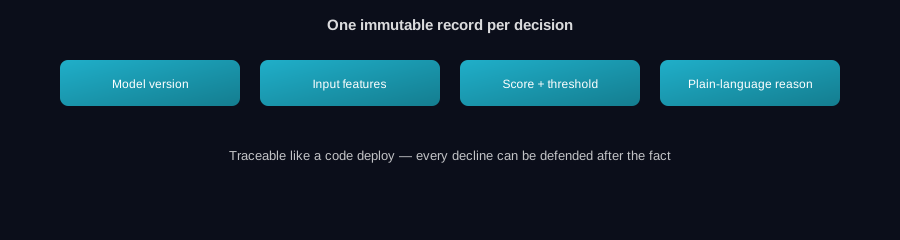
- Record the model version, input features, score, and threshold for every decision, immutably.
- Attach the top reasons for each decline in plain language the customer and the regulator can both understand.
- Version your thresholds and rules; a change in false-positive rate should be as traceable as a code deploy.
Why Tune the Threshold to Cost Instead of Accuracy?
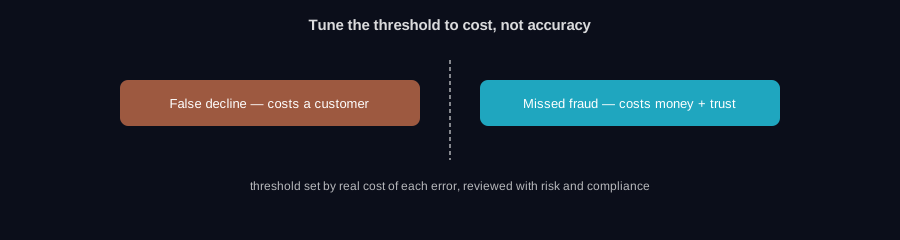
A false decline costs you a customer; a missed fraud costs you money and trust. Set thresholds by the real cost of each error, review them with risk and compliance, and make the trade-off explicit rather than hiding it inside a metric.
In fraud, the model's job is only half the work. The other half is being able to defend every 'no' it produces.
How Do You Stay Ahead of an Adversary That Adapts?
Fraud patterns shift the moment you block them. Monitor for concept drift, retrain on fresh labels, and keep a rules layer for the patterns you can name, so you're never relying on a single model against an opponent that's actively probing it.
Frequently asked questions
Why does a fraud detection model need to be explainable?
Every fraud decline is a customer decision and a potential regulatory question. A model that catches fraud but can't explain why it declined a transaction is unusable in finance. Explainability isn't optional, it's part of the product.
Are black-box deep learning models unusable for fraud detection?
Not unusable, but they need attribution methods layered on top so each flag ships with its top contributing factors. In practice, gradient-boosted trees with clear feature attributions often beat black-box networks because every decision already comes with a readable reason.
What needs to be in a fraud decision audit trail?
The model version, input features, score, and threshold for every decision, recorded immutably, plus the top reasons for each decline in language a customer and a regulator can both understand. Threshold and rule changes should be as traceable as a code deploy.
How do you decide where to set a fraud detection threshold?
By the real cost of each error type, not by raw accuracy. A false decline costs a customer; a missed fraud costs money and trust. Set the threshold by weighing those actual costs, review it with risk and compliance, and make the trade-off explicit.
Why does a fraud model need retraining if it's already accurate?
Fraud patterns shift the moment a pattern gets blocked. Accuracy today doesn't guarantee accuracy next month. Monitoring for concept drift, retraining on fresh labels, and keeping a rules layer for known patterns keeps the model ahead of an adversary that's actively probing it.
Want this built for your team?
We ship production-grade AI like this across every industry, in weeks, not months.