
Local LLM Deployment in the GCC: When On-Prem Beats the API
A local LLM deployment beats calling a hosted API when one of three conditions holds: the data can't legally leave a defined boundary, the workload needs latency an internet round trip can't deliver, or token volume is high enough that fixed infrastructure undercuts per-token billing. Outside those three conditions, the API almost always wins on cost, speed to launch, and model quality. Here is how to tell which situation you're actually in.
 By: Asad Siddiq
"Local LLM" gets pitched as either a compliance requirement or a cost-saving move, and it can be either, but it is rarely both at once, and it is never free. Running a model on your own infrastructure trades a predictable per-token bill for a fixed infrastructure cost, a weaker model than the frontier API you could otherwise call, and an ongoing operational burden someone on your team now owns. For a GCC enterprise, the decision usually turns on one of three things: a data residency rule that rules the API out entirely, a latency requirement the public internet can't meet, or a token volume high enough that the math flips in favor of owning the hardware.
What Is Local LLM Deployment, and How Is It Different From Calling an API?
Calling an API means sending a prompt to a hosted model (OpenAI, Anthropic, Google, or a similar provider) over the internet and paying per token for the response. Local, on-prem, or private LLM deployment means running an open-weight model (Llama, Mistral, Qwen, or similar) on infrastructure you control, whether that is your own data center, a private cloud instance in-region, or a colocated GPU rack. The prompt and the data behind it never leave your defined boundary. That boundary is the entire point: it is what makes local deployment a compliance answer in some cases and an unnecessary cost in others.
Three deployment models, not two
The choice isn't binary. A hosted public API, a private instance of a model inside a cloud provider's region (still someone else's hardware, but data-boundary-controlled), and fully on-premise hardware you own are three distinct points on the same spectrum, each with a different cost and control trade-off. Most GCC enterprises that rule out the public API land on the middle option, not the far end.

When Does On-Prem or Private LLM Deployment Beat API Calls in the GCC?
Three conditions, and you typically only need one of them to justify the switch.
Data residency rules the API out entirely
If the data a prompt carries is regulated personal data, or the workload sits inside a sector with its own residency mandate (banking, healthcare, government), a hosted API that processes and may retain data outside your defined boundary can be a non-starter regardless of cost. This is the single most common reason a GCC enterprise moves to local deployment, and it overrides every other factor in the decision.
Latency the public internet can't deliver
A voice agent handling a live call, a fraud check running inside a payment authorization window, or any workload with a hard round-trip budget under roughly 200-300ms end-to-end is fighting network latency as much as model latency when it calls a public API. Running the model on infrastructure physically close to the workload removes that variable network hop entirely.
Cost at high token volume
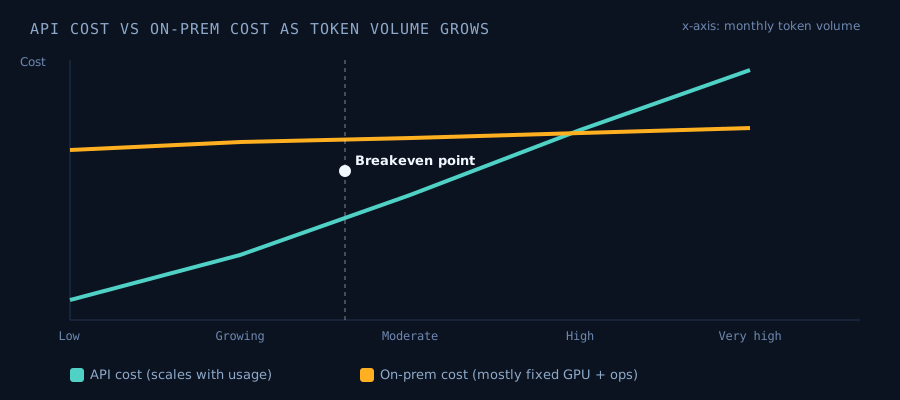
API pricing is per-token and scales linearly with usage. On-prem cost is mostly fixed: GPU hardware, power, and the engineering time to run it, with usage adding comparatively little marginal cost once the hardware is in place. At low-to-moderate volume the API wins easily, since the fixed infrastructure cost has nothing to amortize against. At sustained high volume, sometimes in the range of hundreds of millions of tokens a month depending on model size and hardware choice, the fixed cost starts paying for itself and the lines cross.
What Are the Real Trade-Offs of Running a Local LLM?
None of the three conditions above are free wins. Each comes with a cost most local-LLM pitches leave out.
Weaker frontier performance
The best open-weight models you can self-host are not the best models available, full stop. A frontier hosted API model will usually out-reason, out-code, and handle longer context more reliably than an open-weight model of a size your own hardware can realistically serve. If the task genuinely needs frontier-level reasoning (complex multi-step analysis, nuanced judgment calls), running it locally means accepting a real capability gap, not a marginal one.
Infrastructure cost is front-loaded and real
GPU hardware capable of serving a useful open-weight model at production latency is a genuine capital or committed-cloud-spend cost before a single token gets processed, not an incremental line item. Budgeting local deployment as "basically free after the API bill goes away" is the most common way this decision gets mis-costed.
Maintenance burden doesn't disappear, it moves
An API provider handles model updates, scaling, and uptime as their product. Self-hosted, that work becomes your team's job: patching, scaling under load, monitoring for silent quality drift, and re-evaluating whenever a better open-weight model ships. This is the same MLOps discipline that keeps any production model honest, and it does not get lighter just because the model runs on your own hardware.

How Does GCC Data Residency Law Affect the API vs Local Decision?
In the UAE, personal data handling falls under Federal Decree-Law No. 45 of 2021 on the Protection of Personal Data, and regulated sectors (banking, healthcare, government) typically carry their own residency policy layered on top of it. In practice, that means confirming, before any model is chosen, where a prompt actually gets processed and where any logs or fine-tuning data get stored. A public API whose infrastructure sits outside the UAE, or whose terms allow retaining prompt data for training, can fail that requirement outright regardless of how good the model is. Settling the residency model first (on-premise, UAE-hosted private cloud, or an in-region private instance from a major provider) narrows the vendor list before a single benchmark gets run, and saves the evaluation time spent on options that were never compliant to begin with.
Which Open-Weight Models Are Realistic for On-Prem Deployment Right Now?
The open-weight field moves fast, so treat any specific model name as a snapshot, not a permanent recommendation. What stays stable is the selection criteria: how the model performs on your actual task (not a generic leaderboard), what hardware footprint it needs to serve at your required latency and concurrency, whether it has a commercially usable license for your use case, and how active its fine-tuning and quantization ecosystem is, since that ecosystem is what lets a mid-size model punch above its raw parameter count. Benchmark candidates against your own golden set of real prompts before committing hardware spend to any one of them, the same evaluation discipline behind any production generative AI or LLM deployment, hosted or local.
API, Private Cloud, or Fully On-Prem: How Do You Actually Decide?
- Choose the hosted API if: no hard data residency requirement applies, token volume is low-to-moderate, and the task benefits from frontier-level reasoning. This covers most GCC enterprise AI use cases today, and it is the fastest and usually cheapest path to production.
- Choose a private in-region cloud instance if: data residency rules out the public API, but you don't want to own physical hardware or the operational burden that comes with it. A major cloud provider's in-region private deployment often satisfies the residency requirement without the capital cost of on-premise infrastructure.
- Choose fully on-premise if: residency requirements are strict enough that even a private cloud instance doesn't satisfy them (common in government and some banking workloads), or sustained token volume is high enough that the fixed infrastructure cost has a real payback period against per-token API billing.
Most GCC enterprises land on the hosted API or the private-cloud middle ground. Fully on-premise is the right call for a specific, narrower set of regulated or extreme-volume workloads, not the default starting point.
What Should You Ask Before Committing to Local LLM Deployment?
Ask which regulation or internal policy specifically requires data residency, and get it in writing rather than assuming it applies. Ask what the realistic capability gap is between the open-weight model under consideration and the frontier API alternative, on your actual task, not a generic benchmark. Ask who on your team owns patching, scaling, and drift monitoring after launch, since that person's time is a real ongoing cost the upfront hardware quote won't show. And ask for the token-volume math specifically: at your actual usage, does the fixed infrastructure cost genuinely undercut the API bill, or does it only look that way before the maintenance hours get added in.
Frequently asked questions
What is local LLM deployment?
Running an open-weight language model (such as Llama, Mistral, or Qwen) on infrastructure you control, on-premise or in a private in-region cloud instance, instead of calling a hosted API over the internet. The prompt and its data never leave your defined boundary, which is the entire point for regulated workloads.
Is a local LLM cheaper than using an API like OpenAI or Anthropic?
Only at high sustained token volume. API pricing is per-token and scales linearly with usage; on-prem cost is mostly fixed hardware and engineering time. At low-to-moderate volume the fixed cost has nothing to amortize against, so the API wins. The crossover depends on model size and hardware choice, but it only favors on-prem past a real volume threshold, not by default.
Do open-weight models perform as well as GPT-class or Claude-class models?
No, not on complex reasoning, coding, or long-context tasks. The best open-weight models you can realistically self-host trail frontier hosted APIs on capability. Running locally means accepting that gap in exchange for data control or cost at scale, not getting the same model quality for free.
Does UAE data residency law require on-premise AI deployment?
Not automatically. Federal Decree-Law No. 45 of 2021 on the Protection of Personal Data governs how personal data is handled, and regulated sectors often layer their own residency policy on top. A private in-region cloud instance can satisfy many residency requirements without full on-premise hardware; confirm which model your specific regulation or policy actually requires before assuming you need on-prem.
What's the biggest hidden cost of running a local LLM?
Ongoing maintenance: patching, scaling under load, and monitoring for quality drift, work an API provider otherwise handles as their product. Teams that budget only the GPU hardware cost and skip the engineering time to run it consistently under-cost local deployment by a wide margin.
Want this built for your team?
We ship production-grade AI like this across every industry, in weeks, not months.