
Retail AI in the UAE: Recommendation Engines, Forecasting, and Visual Search
Retail AI in the UAE runs on three connected systems: recommendation engines that lift revenue per visit, demand forecasting that cuts inventory wastage, and visual search that shortens the path from a photo to a purchase. Our own client work across the sector has cut inventory wastage by 28% once forecasting replaced manual reordering. This guide covers what each system actually does, how they connect, and the build-vs-buy call UAE retailers face before committing budget to any of them.
 By: Asad Siddiq
Ask three different retail AI vendors what "retail AI" means and you'll get three different scopes: a chatbot vendor means customer service, a martech vendor means personalization pop-ups, and an inventory vendor means forecasting software. None of them is wrong, but none of them is the whole picture either. For a UAE retailer, the systems that actually move revenue and cut cost sit in three places: what you recommend, how much you stock, and how customers find what they're looking for. This guide treats all three as one connected strategy, not three separate vendor conversations.
What Is Retail AI, and Which Systems Actually Move Revenue in the UAE?
Retail AI is the set of machine learning systems that decide what to show a customer, how much stock to hold, and how a product gets found, replacing rules and manual review with models trained on live behavior and sales data. In practice, three systems account for almost all of the measurable return: recommendation engines, demand forecasting, and visual search. Applied well, our own retail industry client work has cut inventory wastage by 28%, one of the clearer payback numbers in enterprise AI.
The Three Systems That Actually Move Revenue
- Recommendation engines: personalize what a shopper sees based on real-time behavior, lifting revenue per visit rather than just click-through.
- Demand forecasting: predicts SKU-level demand so stock, not guesswork, drives reordering, cutting both stockouts and overstock wastage.
- Visual search: lets a shopper search with a photo instead of a text query, shortening the path from seeing a product to buying it.
Why UAE Retail Is a Fast-Moving Market for This
The UAE AI in Retail and Personalization market is valued at USD 340 million and growing, driven by a retail base that runs bilingual Arabic/English catalogs, mall-anchored physical retail alongside e-commerce, and demand swings around Ramadan and Eid that a generic global forecasting model was never tuned for. That combination is exactly why UAE retailers can't just import a Western retail AI playbook unchanged; the underlying data patterns are genuinely different.
How Do Recommendation Engines Fit Into a Retail AI Strategy?
Recommendation engines are the most mature of the three systems and usually the first one a UAE retailer should build, because the return is the most directly measurable. We've covered the full mechanics, signal, speed, and measurement, in our dedicated guide on recommendation engines that lift revenue; the summary that matters for a retail AI strategy is below.
Signal: Behavior Beats Purchase History
Session behavior, clicks, dwell time, cart adds, carries more intent than sparse purchase history, and the best recommenders blend both rather than picking one. This is standard machine learning practice applied to a live retail catalog rather than a static dataset.
Speed: Real Time or the Recommendation Is Wasted
A recommendation panel that renders after the shopper has scrolled past it contributes nothing. Precompute embeddings offline, rank the shortlist live against the session, and hold end-to-end latency to a strict budget, typically under 100 milliseconds.
Measurement: Incremental Lift, Not Clicks
A recommender can post a high click-through rate while adding zero revenue, because it recommends what the shopper would have bought anyway. Test against a randomized holdout and measure revenue per visitor, not click-through, before calling any recommender a win.
How Does Demand Forecasting Cut Inventory Costs for UAE Retailers?
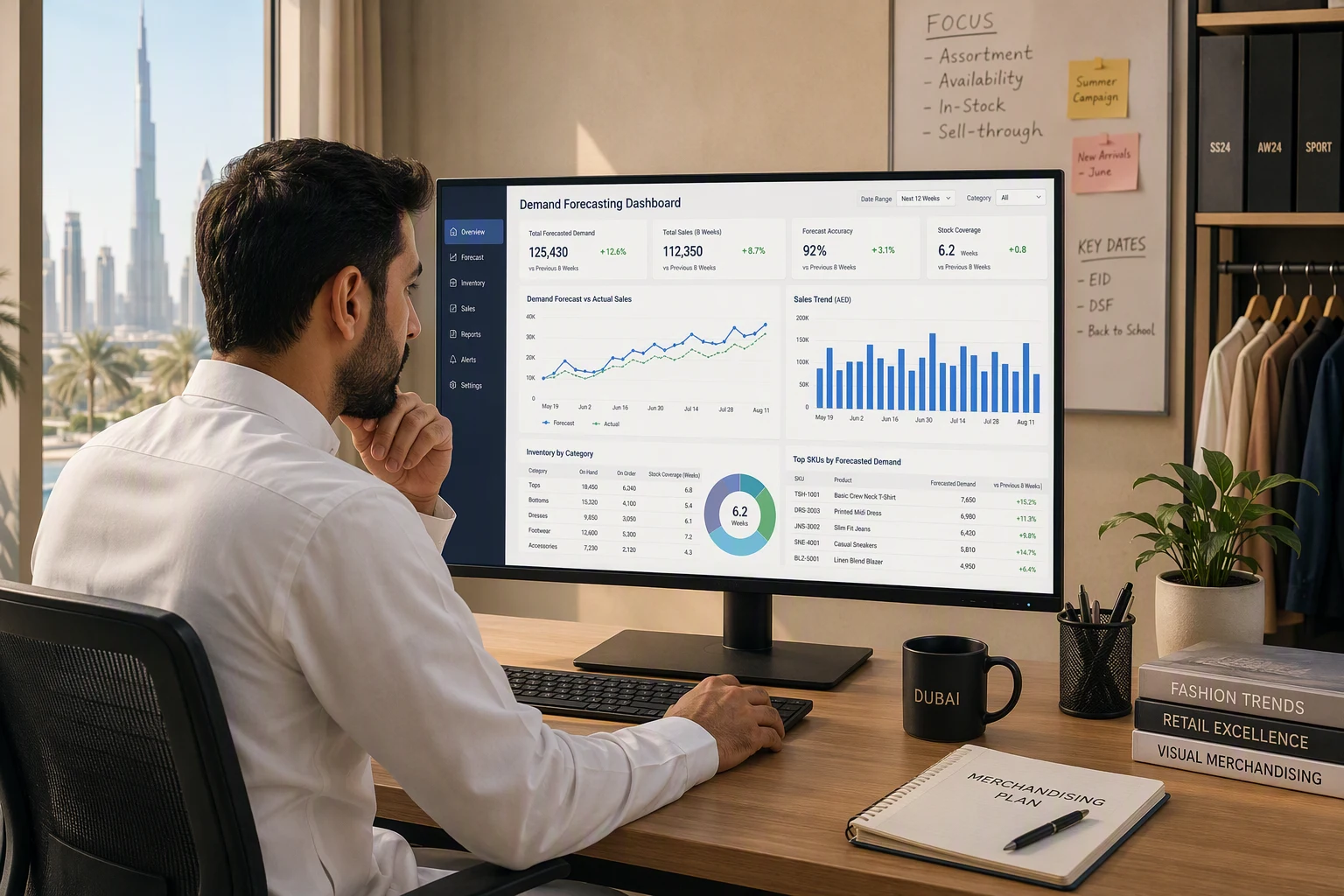
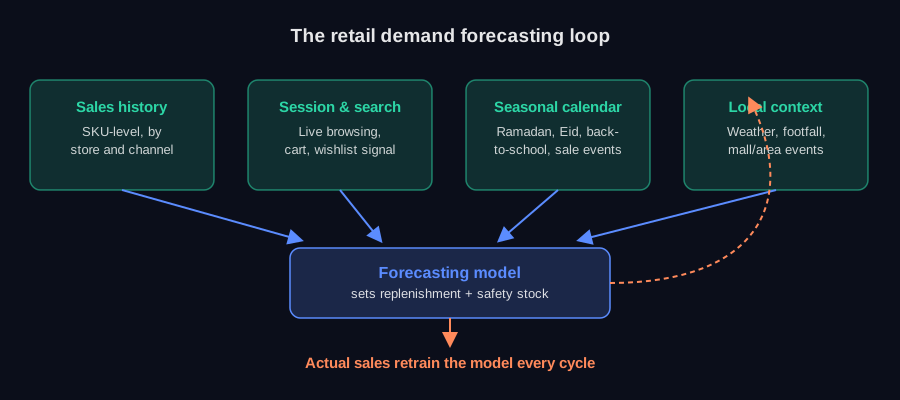
Demand forecasting replaces manual reordering rules with a model trained on sales history, live session signal, and a seasonal calendar built for the region it actually serves. For UAE retailers specifically, that means Ramadan, Eid, and back-to-school swings, not Black Friday and Christmas, which is where a lot of off-the-shelf, US-built forecasting tools quietly underperform.
Setting Safety Stock With a Live Model, Not a Static Buffer
Most retailers still set safety stock as a flat percentage buffer on top of average demand, a rule that overstocks slow SKUs and understocks fast ones at the same time. A live forecasting model sets safety stock per SKU based on actual demand variance, which is the single biggest lever behind the wastage reduction retailers see once forecasting replaces manual reordering.
Ramadan, Eid, and the GCC's Sharpest Seasonal Swings
Global forecasting tools are tuned against a Western retail calendar and treat Ramadan and Eid as noise rather than signal, which is exactly backward for a UAE catalog where those windows can represent the sharpest demand swings of the year. A forecasting model trained on the actual regional calendar, not a generic one, is one of the clearer originality gaps between an off-the-shelf tool and a build scoped for this market.
SKU-Level Granularity Beats Category-Level Averages
A category-level forecast for "footwear" smooths over the fact that one sneaker SKU is trending and another is dead stock, which is precisely the blend that produces both a stockout and a markdown in the same store in the same week. Forecasting at the SKU level, by store and by channel, is more compute-intensive but is what actually separates a forecasting system that earns its keep from one that just adds a dashboard.
What Is Visual Search and Why Are UAE Shoppers Adopting It Fast?
Visual search lets a shopper point a camera at a product, in-store, on social media, or on a friend's bag, and get matching or similar items back instead of typing a text query. Adoption has grown fast: monthly visual searches on Google Lens roughly tripled from 3 billion in 2021 to 10 billion by early 2023, and that curve has kept climbing since. For a mobile-first, mall-heavy retail market like the UAE, a shopper standing in front of a display case is exactly the visual-search use case the technology was built for.
How Visual Search Actually Works Under the Hood
A computer vision model converts the query image into an embedding, then matches it against embeddings precomputed for every product in the catalog, returning the closest visual matches ranked by similarity. It's the same nearest-neighbor matching problem a recommendation engine solves, applied to image vectors instead of behavioral ones.
Why Mobile-First GCC Shopping Behavior Favors Visual Search
UAE retail is unusually mall-anchored for a market this digitally mature, which means a large share of product discovery still happens in front of a physical shelf or display, exactly where typing a text search is awkward and pointing a phone camera is not. Visual search closes the gap between in-store browsing and online purchase in a way text search never could.

What Your Product Catalog Needs Before Visual Search Works
Visual search is only as good as the catalog images and metadata behind it. Low-resolution product photography, inconsistent backgrounds, and missing attribute tags (color, material, pattern) all degrade match quality before the model itself is even a factor. Audit catalog photography and metadata completeness before scoping a visual search build, not after launch when the match rate disappoints.
Build vs Buy: How Should a UAE Retailer Approach Retail AI Adoption?
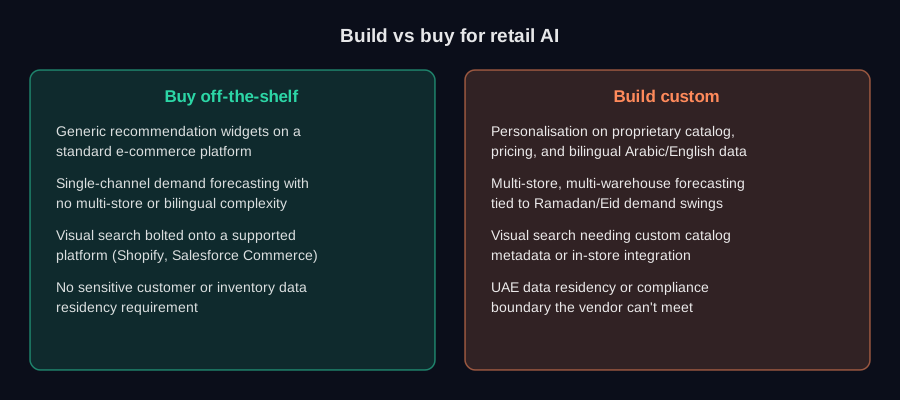
Buy an off-the-shelf tool when the workflow is generic and well-served by an existing platform: standard recommendation widgets on Shopify or Salesforce Commerce, single-channel forecasting with no multi-store complexity, or visual search bundled into a platform you already run. Build custom when the system needs to reason over a bilingual catalog, coordinate across multiple stores and warehouses against a GCC-specific seasonal calendar, or meet a data residency requirement the vendor's hosting model can't satisfy.
What Should You Ask Before Choosing a Retail AI Partner in the UAE?
Ask which of the three systems, recommendation, forecasting, or visual search, they've actually shipped for a bilingual Arabic/English catalog, not just a generic English-only one. Ask how the forecasting model handles Ramadan and Eid specifically, not "seasonality" as a generic checkbox. Ask what happens to match quality on visual search if catalog photography is inconsistent, since that's the most common reason a pilot underperforms. And ask where the holdout test sits in their measurement plan for any recommendation system, since a vendor that can't show incremental lift against a holdout is selling a demo, not a result.
Frequently asked questions
What is retail AI?
Retail AI is the set of machine learning systems that decide what to recommend, how much stock to hold, and how products get found, replacing manual rules with models trained on live behavior and sales data. In practice it breaks down into three systems: recommendation engines, demand forecasting, and visual search.
Which retail AI system should a UAE retailer build first?
Recommendation engines, in most cases. They have the most mature tooling, the clearest measurement method (incremental lift against a holdout), and typically the fastest payback of the three systems.
How much can AI demand forecasting reduce inventory costs?
Our own retail client work has seen inventory wastage cut by 28% after replacing manual reordering with SKU-level forecasting that sets safety stock from actual demand variance rather than a flat buffer.
Does demand forecasting need to account for Ramadan and Eid separately?
Yes. Generic forecasting tools built around a Western retail calendar treat Ramadan and Eid as noise, which is backward for a UAE catalog where those windows often produce the sharpest demand swings of the year. A model trained on the actual regional calendar performs materially better.
Is visual search worth building for a UAE retailer?
It's a strong fit for mall-anchored, mobile-first retail specifically, since a shopper in front of a physical display is the exact use case visual search solves. The return depends heavily on catalog photography and metadata quality, which should be audited before committing to a build.
Want this built for your team?
We ship production-grade AI like this across every industry, in weeks, not months.