
Shipping HIPAA-ready clinical AI without slowing down
Healthcare teams assume compliance and speed are opposites. They aren't. The projects that stall are the ones that treat HIPAA as a review at the end. The ones that ship treat it as an architecture decision at the start.
 By: Asad Siddiq
Clinical AI lives or dies on trust: of regulators, of hospital IT, and above all of the clinician who has to act on the output. Any AI vendor touching patient data at a HIPAA covered entity, hospitals, health plans, and clearinghouses, inherits the same compliance obligations as the entity itself. Every design choice below serves that trust while keeping the team moving, whether you're building imaging pipelines or the broader mix of AI for healthcare and life sciences teams are shipping across the Gulf.
How Do You Minimize PHI Before the Model Ever Sees It?
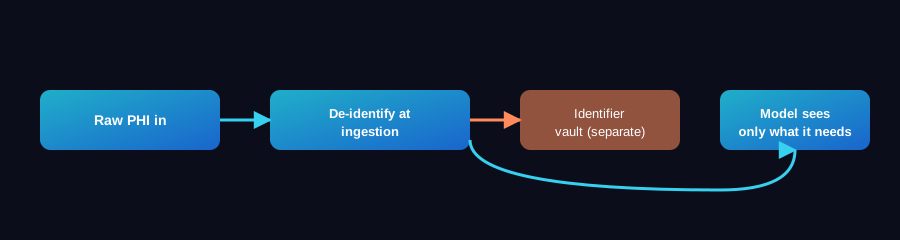
The less protected health information flows through your system, the smaller your compliance surface. De-identify at ingestion, keep identifiers in a separate vault, and pass the model only what it needs. A pipeline that never touches raw PHI is dramatically cheaper to audit.
How Do You Make Every Prediction Explainable and Traceable?
- Attach a saliency map or evidence snippet to every imaging or NLP output so a clinician can see why.
- Log the model version, input hash, and confidence for every prediction. This is your audit trail and your debugging tool.
- Never present a score without a clear, clinician-facing action: flag, defer, or route. It's the same explainability discipline that makes any model defensible.
Why Keep the Human in the Loop by Design?
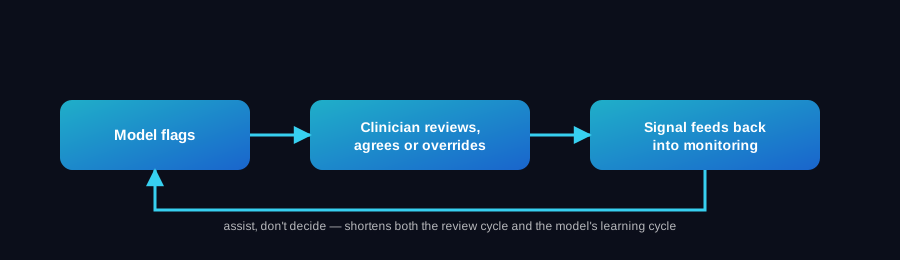
The safest and fastest path to approval is a system that assists rather than decides. Frame the model as a triage or second-reader tool, capture the clinician's agreement or override, and feed that signal back into monitoring. It shortens both the review cycle and the model's learning cycle.
Clinicians don't reject AI because it's inaccurate. They reject it when they can't see how it reached its answer.
How Do You Monitor a Clinical Model for Drift?
A new scanner, a new coding standard, or a seasonal shift in case mix can silently degrade a clinical model. Track input distributions and output rates continuously, and alert on drift the same way you'd alert on a failing service. The same monitoring discipline that keeps a computer vision imaging pipeline honest applies here too. Compliance isn't a launch gate. It's a running system.
Frequently asked questions
Does HIPAA compliance slow down a clinical AI deployment?
Not if it's designed in from the start. Projects stall when teams treat compliance as a review at the end; treating it as an architecture decision (de-identification, audit trails, human oversight built in from day one) lets teams ship on time.
How do you minimize PHI exposure in a clinical AI pipeline?
De-identify data at ingestion, keep identifiers in a separate vault from the working dataset, and pass the model only what it strictly needs. A pipeline that never touches raw PHI has a dramatically smaller compliance surface to audit.
Why does every clinical AI prediction need to be explainable?
Clinicians don't reject AI for being inaccurate. They reject it when they can't see how it reached an answer. A saliency map or evidence snippet on every prediction, plus a logged model version and confidence score, is what makes a model defensible and trusted.
Should clinical AI make the final decision or assist a clinician?
Assist. Framing the model as a triage or second-reader tool (one that captures the clinician's agreement or override) is both the safest path and the fastest path to approval, and it feeds a training signal back into the model.
How do you catch a clinical model degrading after launch?
Monitor input distributions and output rates continuously, the same way you'd monitor uptime on any production service. A new scanner, coding standard, or seasonal case-mix shift can silently degrade accuracy without a single error being thrown.
Want this built for your team?
We ship production-grade AI like this across every industry, in weeks, not months.