
Voice AI agents that don't sound like robots
People forgive a chatbot that pauses. They hang up on a voice agent that does. Voice is unforgiving because we've spent our whole lives reading the rhythm of human conversation, and the model has milliseconds to match it.
 By: Asad Siddiq
A great voice agent is an engineering problem disguised as a personality problem. This is the discipline our voice AI agents practice is built around. The 'personality' emerges almost entirely from three things: how fast it responds, how it handles interruption, and whether it actually knows what it's talking about.
Why Is Latency the Whole Game for Voice AI?
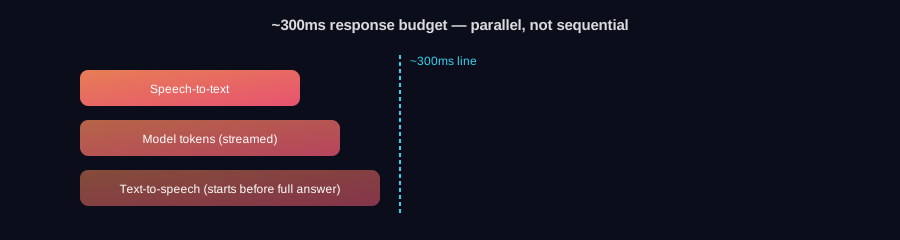
Humans expect a reply within roughly 300 milliseconds. ITU-T's own transmission-delay standard puts the threshold even tighter for high-quality conversation, under 150ms one-way, with anything past 300ms measurably degrading how natural a call feels. Cross a second and the caller assumes the line dropped. Stream everything (speech-to-text, model tokens, and text-to-speech) in parallel rather than in sequence, and start speaking before the full answer is generated.
What Makes Turn-Taking Feel Alive Instead of Robotic?
- Detect barge-in: when the caller starts talking, the agent must stop instantly, not finish its sentence.
- Use backchannels: a short 'mm-hm' or 'got it' so the caller knows they were heard while the model thinks.
- Vary pacing and add natural fillers sparingly; perfectly fluent speech reads as robotic.
Why Ground Every Answer Instead of Letting It Improvise?
A voice agent that invents a policy on a recorded call is a liability, not a feature. Ground every factual answer in retrieval over your real knowledge base, and give the agent a confident, human way to say 'let me check that for you' when it isn't sure. Then actually check.
Nobody notices a voice agent that works. They only remember the half-second of silence that made them say 'hello? are you there?'
Why Design the Handoff, Not Just the Conversation?
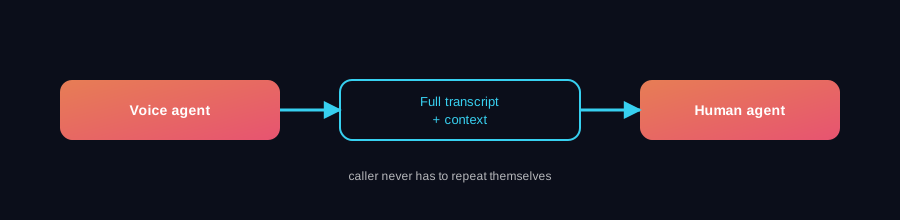
The mark of a mature voice system isn't that it never needs a human. It's that the handoff is seamless. Pass the full transcript and context to the agent taking over, so the caller never has to repeat themselves. A clean escalation earns more trust than a stubborn bot. This is exactly the pattern we see working for real estate teams fielding after-hours viewing calls.
Frequently asked questions
Why does a voice AI agent need to respond within 300 milliseconds?
Humans expect a reply within roughly 300ms in normal conversation. Cross a second and the caller assumes the line dropped or the system failed. Streaming speech-to-text, model tokens, and text-to-speech in parallel, instead of sequentially, is what keeps responses inside that window.
What is barge-in detection and why does it matter?
Barge-in is when the caller starts talking while the agent is still speaking. A voice agent that can't detect this and stop instantly, instead of finishing its sentence, feels robotic and frustrates callers who are used to natural human turn-taking.
How do you stop a voice AI agent from making things up?
Ground every factual answer in retrieval over your real knowledge base rather than letting the model generate from memory. When the agent isn't confident, it should say 'let me check that for you' and actually check, not improvise a plausible-sounding answer.
Should a voice AI agent ever transfer to a human?
Yes. The mark of a mature system is a seamless handoff, not avoiding humans entirely. Passing the full transcript and context to the human agent means the caller never has to repeat themselves, which builds more trust than a bot that refuses to escalate.
What makes voice AI agents in the UAE different from a chatbot?
Voice has zero tolerance for latency or awkward pauses the way text chat does. Callers hang up on delays they'd happily wait out in a chat window. UAE enterprise deployments also need agents that handle Arabic-English code-switching naturally, not just accurate transcription.
Want this built for your team?
We ship production-grade AI like this across every industry, in weeks, not months.