
AI in Banking & Fintech UAE: The Complete Automation Guide
UAE banks, fintechs, payment companies, lending platforms and exchange or remittance houses are under pressure from three directions at once: fraud is evolving faster than static rules can catch, DIFC and CBUAE regulators are tightening compliance requirements, and customers expect instant onboarding that used to take days. AI for banking and financial services addresses all three: not as separate projects, but as a unified system where fraud scoring, KYC verification, reconciliation and regulatory reporting share the same data pipeline and audit trail.
 By: Asad Siddiq
Our machine learning approach builds fraud, reconciliation and compliance systems that score in real time and explain every decision. That's the shared need across every UAE financial operator, regardless of whether the entity holds a banking licence or moves money as a fintech, payment processor, lender, or exchange house. The urgency is measurable: the global banking fraud landscape hit $33.41 billion in losses in 2024 (Nilson Report, 2025), and McKinsey estimates that AI-driven fraud detection alone could save the industry $10 billion annually by 2027. For UAE financial institutions of every kind, the question is no longer whether to adopt AI: it is how to deploy it in a way that satisfies DIFC data-residency rules, CBUAE audit requirements, and PCI-DSS mandates without slowing down legitimate transactions.
Why Are UAE Banks and Fintechs Investing in AI Automation Now?
Three converging forces are driving the urgency. First, traditional rule-based fraud engines miss new attack patterns: PwC's 2024 Global Economic Crime Survey found that 46% of financial services organisations experienced fraud in the past 24 months, with AI-powered attacks growing fastest. Second, the UAE's Personal Data Protection Law (PDPL) and DIFC's Data Protection Law 2020 require auditable, explainable automated decisions. Black-box models that cannot justify a declined transaction or flagged account are a compliance liability. Third, customer expectations have shifted: a 2025 Salesforce financial services study found that 78% of banking customers expect account opening to complete in under 10 minutes, up from 45% in 2022. Fintech and payment challengers set that expectation just as much as banks do.
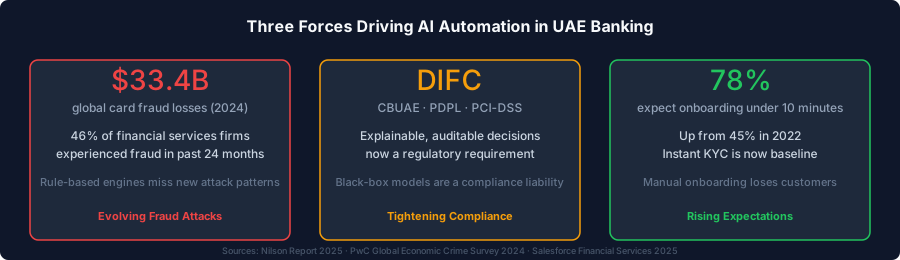
These forces create a specific architectural requirement: AI systems that score in real time, explain every decision, and produce audit trails that survive a regulator's questions, all without replacing the core banking or payment-processing platform underneath.
Does This Guide Apply to Fintechs, Payment Companies, and Exchange Houses, Not Just Banks?
Yes. Banks, fintech lenders, payment processors, and exchange or remittance houses share the same underlying problem: high transaction volume, thin compliance margin, and manual work that doesn't scale linearly with growth. The fraud, KYC/AML, and compliance-automation sections below apply directly to all four; the section on reconciliation and settlement operations further down is written specifically for payment, lending and exchange/remittance operators, where manual reconciliation (not fraud or onboarding) is usually the biggest cost.
- Banks and licensed lenders: the fraud detection, KYC/AML, credit scoring, and CBUAE compliance-reporting sections apply directly.
- Payment companies and payment processors: fraud detection and the reconciliation/settlement section below are the highest-leverage starting points.
- Exchange and remittance houses: AML pattern detection (structuring, layering, geographic anomalies) and multi-currency reconciliation carry the most operational cost. Start there.
- Fintech lending platforms: credit scoring and underwriting-operations automation (below) typically deliver the fastest measurable ROI.
What Is AI-Powered Fraud Detection in Banking?
AI fraud detection replaces static rule thresholds with adaptive models that learn from transaction patterns, device signals, and behavioural data simultaneously. Instead of a fixed rule like 'flag any transaction over AED 50,000', the model evaluates 100+ signals in under 10 milliseconds, including location, time, merchant category, device fingerprint, spending velocity, and peer-group behaviour, to produce a risk score that adjusts to context.
How Do Explainable Models Differ From Black-Box Approaches?
Gradient-boosted tree models and interpretable ensemble methods outperform deep learning for banking fraud because they produce a feature-importance breakdown for every decision. A regulator asking 'why was this transaction flagged?' gets a concrete answer: 'transaction velocity was 3.2x the customer's 30-day average, the merchant category had 12% historical fraud rate, and the device fingerprint was new.' Black-box neural networks score higher on raw accuracy but fail the explainability test that DIFC and CBUAE regulators require.
Every flagged transaction must survive a regulator's questions. If the model cannot explain why it scored 0.87 instead of 0.42, the score is a compliance liability, not a fraud defence.
What Does a Real-Time Fraud Scoring Architecture Look Like?
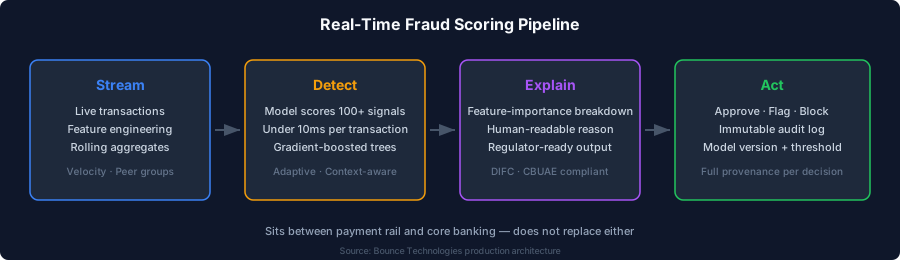
The production architecture follows a Stream → Detect → Explain → Act pipeline. Transactions stream into a feature-engineering layer that computes real-time aggregates (rolling averages, velocity counts, peer comparisons). The model scores each transaction in under 10ms. The explanation engine generates a feature-importance breakdown. The action layer routes the decision (approve, flag, block) with an immutable audit log capturing model version, input features, score, threshold, and timestamp. This pipeline sits between the payment rail and the core banking system, not inside either.

How Does AI Automate KYC and AML Compliance?
KYC/AML automation uses document intelligence, watchlist screening, and risk scoring to compress onboarding from days to minutes. A customer uploads Emirates ID, passport, and proof of address. Computer vision extracts structured data, validates document authenticity (hologram detection, font matching, tamper checks), and cross-references against local and international watchlists, all in a single pass. The system produces a risk-scored onboarding package with every verification step documented for audit.

How Does Arabic Document Intelligence Affect KYC?
GCC banks routinely handle Arabic-language documents (Emirates IDs, Arabic contracts, government correspondence) mixed with English in the same onboarding flow. Native Arabic NLP is not a translation layer bolted onto English OCR. It is a model trained on Arabic document layouts, dialect variations, and right-to-left formatting that extracts fields with the same accuracy as English-language processing. Banks using Arabic translation pipelines instead of native Arabic models see 15-20% lower extraction accuracy on government-issued Arabic documents, creating manual review bottlenecks that defeat the purpose of automation.
What AML Red Flags Does AI Detect That Rules Miss?
Rule-based AML systems flag individual transactions that exceed thresholds. AI-powered AML detects patterns across time, accounts, and jurisdictions: structuring (multiple small deposits designed to stay under reporting thresholds), layering (funds moving through 3+ accounts in 48 hours), and geographic anomalies (transactions with high-risk jurisdictions that individually appear normal). The FATF's 2024 report on financial crime typologies notes that AI systems detect 40-60% more suspicious activity patterns than rule-based systems while producing fewer false positives per alert.
How Does AI Credit Scoring Work for UAE Banks?
AI credit scoring assesses risk on 100+ signals beyond traditional bureau scores: transaction history, business cash flow patterns, industry benchmarks, payment timing, and even macroeconomic indicators. For UAE banks serving SMEs and corporate clients, this means evaluating creditworthiness for businesses with thin credit files or complex multi-entity structures that bureau scores handle poorly.
The practical impact: banks using AI credit scoring approve 15-25% more creditworthy applicants that traditional models reject, while maintaining or reducing default rates. The model identifies applicants whose risk profile is low despite limited bureau history: young businesses with strong cash flow, established operators in volatile industries with seasonal patterns, or cross-border traders with legitimate transaction complexity.
How Do Lending Platforms Automate Underwriting Operations?
For fintech lending platforms, the operational bottleneck usually isn't the credit model. It's everything around it: manually chasing missing bank statements, re-keying data from PDFs into the underwriting system, and routing edge cases through email instead of a queue. Automating document intake (bank statement parsing, cash-flow extraction) and pairing it with the credit-scoring model above compresses underwriting from a multi-day manual review to a same-day decision for the majority of applications, with only genuine edge cases reaching a human underwriter.
How Do Payment, Lending and Exchange/Remittance Companies Automate Manual Reconciliation?
Fraud and onboarding get the attention, but for payment processors, lending platforms and exchange or remittance houses, the largest hidden cost is usually manual reconciliation: an operations team matching transactions across ledgers, payment rails, and bank statements by hand, then chasing every mismatch by email or spreadsheet. This is high-volume, repetitive, rule-governed work, exactly what AI-driven reconciliation automates without touching the underlying payment rails or ledgers.
What Does AI-Driven Transaction Reconciliation Look Like?
The system ingests transaction records from every source: payment gateway, bank statement, internal ledger, correspondent-bank feed, and matches them on amount, timestamp window, and counterparty signals instead of exact-string matching. Records that match automatically close. Records that don't match within a tolerance window get scored by likely cause (timing lag, FX rounding, duplicate submission, genuine error) and routed to the right queue. Most exceptions resolve themselves within the settlement window, and only true anomalies need a human to look at them.

How Does AI Handle Settlement Exceptions Across Multiple Currencies?
Exchange and remittance houses reconcile across multiple currencies and correspondent banks simultaneously, where FX timing differences and rounding create a constant stream of small mismatches that rule-based systems flag as errors even when they're expected. An AI reconciliation layer models the expected FX-timing and rounding tolerance per corridor, so it stops surfacing normal settlement noise as exceptions and instead surfaces the mismatches that are actually irregular, the ones that need investigation.
Most reconciliation exceptions aren't fraud and aren't errors. They're timing. The model that can tell the difference is the one that actually cuts headcount on the ops queue.
The same feature-engineering pipeline used for fraud scoring and AML detection feeds this reconciliation layer, so a payment company or remittance house doesn't build a separate system. Reconciliation becomes another consumer of infrastructure it's already paying for.
What Is a Banking Copilot and How Does It Reduce Operational Load?
A banking copilot is an AI assistant that handles Tier-1 customer and operations queries 24/7: balance inquiries, dispute initiation, card actions, transaction lookups, and product guidance. It reduces call centre volume by 30-40% while maintaining the human escalation path for complex cases. For UAE banks, the copilot must support bilingual Arabic-English interaction in the same conversation, handle dialect variations, and route to human agents with full context when the model is uncertain.
How Does a Banking Copilot Maintain Compliance?
The copilot operates under strict guardrails: it never makes account changes without human confirmation, logs every interaction for audit, and enforces data-access controls that prevent the model from surfacing information the requesting user is not authorised to see. Compliance-sensitive queries (large transfers, account closures, regulatory disputes) automatically route to human agents with a pre-filled context summary.
How Does Compliance Automation Replace Manual Regulatory Reporting?
Compliance automation generates regulatory reports from live transaction data, monitors for policy violations in real time, and produces audit-ready documentation without manual compilation. Instead of a compliance team spending 3-5 days monthly assembling CBUAE reports from spreadsheets, the system pulls from the same data pipeline used for fraud and credit scoring, applies regulatory templates, flags anomalies, and produces submission-ready documents with full provenance tracking.
The architecture advantage is shared infrastructure: the same feature-engineering pipeline, model-serving layer, and audit log that power fraud detection also feed compliance reporting. This eliminates the data duplication and inconsistency that plague banks running separate systems for risk, fraud, and compliance.
How Should a UAE Bank or Fintech Start an AI Automation Initiative?
Start with the highest-cost problem: if fraud losses are the largest leak, begin with AI fraud detection. If onboarding friction is losing customers, begin with KYC automation. If manual reconciliation is consuming the operations team, begin there. If compliance reporting is consuming the most analyst time, begin with regulatory automation. Each path shares the same underlying architecture (feature pipeline, model serving, audit log), so the first initiative builds infrastructure that accelerates the second and third.
What Does a Phased Rollout Look Like?
- Phase 1 (4-6 weeks): Audit existing systems, identify highest-cost decision, build feature pipeline on one data source, deploy a single model with full audit trail.
- Phase 2 (6-8 weeks): Expand to 2-3 use cases sharing the same pipeline (fraud + KYC, or compliance + credit scoring) and validate cross-use-case data quality.
- Phase 3 (ongoing): Add MLOps monitoring for model drift, retraining triggers, and compliance reporting automation. Scale to additional business lines.
Operators that start with a single narrow use case and prove measurable ROI in 6-8 weeks earn the internal buy-in to expand. Operators that attempt a platform-wide AI transformation in one phase typically stall at the integration layer, where legacy core banking or payment-processing systems resist wholesale replacement.
What Compliance Standards Must AI Systems Meet in the UAE?
AI systems in UAE banking must satisfy overlapping regulatory frameworks: PCI-DSS for payment data, DIFC Data Protection Law 2020 for data residency and processing, CBUAE regulations for operational risk and reporting, and PDPL for personal data handling. The architectural requirement is compliance-first design: the system is built to PCI-DSS, SOX, and GDPR standards from day one, not retrofitted after deployment.
Explainability is non-negotiable: every automated decision must produce a human-readable explanation of the factors behind it. Immutable audit trails must capture model version, input features, decision threshold, timestamp, and the identity of any human who overrode the model. This is not optional best practice. It is a regulatory requirement for any AI system making decisions that affect customer accounts.
What ROI Can a UAE Bank or Fintech Expect from AI Automation?
Measured outcomes from production deployments across GCC financial institutions show consistent patterns: fraud losses reduced 40-42%, false declines reduced 60%, KYC onboarding time compressed from days to minutes, reconciliation exception volume cut sharply for payment and remittance operators, and compliance reporting effort reduced by 70-80%. The shared-infrastructure architecture means the ROI compounds: the fraud detection pipeline feeds credit scoring and reconciliation, which feed compliance reporting, so each additional use case costs less to deploy than the first.
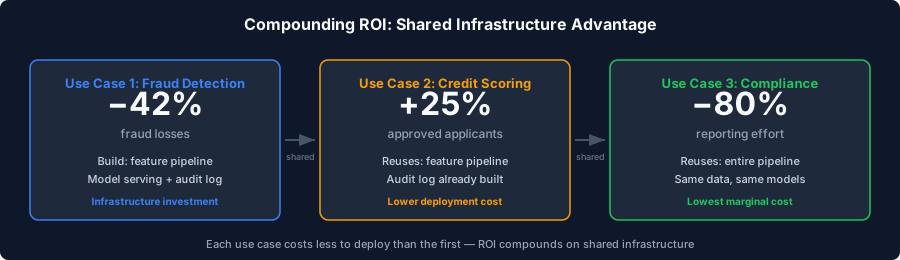
The ROI of AI in banking is not a single number. It is a compounding curve: each use case deployed on shared infrastructure costs less than the last, while the combined risk reduction, revenue recovery, and operational savings multiply.
How Do You Choose the Right AI Partner for UAE Banking?
Evaluate vendors on four criteria that directly affect production success: native Arabic document intelligence (not translation layers), explainable model architecture (not black-box deep learning for any customer-facing or compliance-critical decision), core-platform integration experience (the system must sit between the payment rail and the core, not replace either), and GCC regulatory knowledge (DIFC, CBUAE, PDPL compliance baked into the architecture, not bolted on after deployment).
The vendor must demonstrate production-grade deployment on similar platforms, not just proof-of-concept demos. For banks, ask for reference architectures showing integration with Temenos, FIS, or Finastra. For fintechs, payment companies, and exchange/remittance houses, ask the same question about your payment gateway, ledger system, or correspondent-banking rails. If the vendor cannot name the specific integration points for your actual platform, the deployment will stall at the integration layer.
What Is the Bottom Line for UAE Banks and Fintechs Considering AI?
AI automation across UAE banking and fintech is no longer optional. It is the baseline for competitive fraud detection, customer onboarding, reconciliation, and regulatory compliance. The operators that deploy first gain a measurable advantage: lower fraud losses, fewer false declines, faster onboarding, leaner reconciliation queues, and audit-ready compliance. The ones that wait face a widening gap as competitors automate and customer expectations rise.
Start with one high-cost problem. Build on shared infrastructure. Prove ROI in 6-8 weeks. Then expand. The architecture you build for the first use case becomes the foundation for every subsequent one. The compounding advantage is what separates the operators that lead from the ones that follow.
Frequently asked questions
How does AI fraud detection work in UAE banks?
AI fraud detection scores every transaction in under 10ms using 100+ signals: device fingerprint, spending velocity, merchant risk, peer-group behaviour, instead of static thresholds. Gradient-boosted tree models produce a feature-importance breakdown for every decision, so flagged transactions survive regulatory audit.
What regulations apply to AI systems in UAE banking?
AI systems must comply with PCI-DSS for payment data, DIFC Data Protection Law 2020 for data residency, CBUAE regulations for operational risk, and PDPL for personal data handling. Explainability and immutable audit trails are regulatory requirements, not optional best practices.
How long does it take to deploy AI automation in a bank?
A single use case (fraud detection, KYC automation, or compliance reporting) deploys in 4-6 weeks on shared infrastructure. Expanding to 2-3 additional use cases takes another 6-8 weeks because the feature pipeline and audit log are already built.
Can AI handle Arabic-language banking documents?
Yes, but only with native Arabic NLP, not translation layers. Banks using translation-based Arabic processing see 15-20% lower extraction accuracy on government-issued Arabic documents like Emirates IDs and Arabic contracts. Native models trained on Arabic layouts and dialect variations match English-language accuracy.
What ROI do UAE banks see from AI automation?
Measured outcomes include 40-42% reduction in fraud losses, 60% fewer false declines, KYC onboarding compressed from days to minutes, and 70-80% reduction in compliance reporting effort. ROI compounds as additional use cases share the same infrastructure.
Does this apply to fintechs and payment companies, or only licensed banks?
It applies to all of them. Banks, fintech lenders, payment processors, and exchange/remittance houses share the same core problem: high transaction volume and thin compliance margin. Fraud detection and KYC/AML apply to every operator; reconciliation and settlement-exception automation is usually the highest-leverage starting point specifically for payment, lending and exchange/remittance companies.
How does AI reduce manual reconciliation for payment and remittance companies?
AI reconciliation matches transactions across payment gateways, bank statements, and ledgers on amount, timing window, and counterparty signals instead of exact-string matching, auto-closing matched records and routing only genuine exceptions to an ops queue. It also models expected FX-timing and rounding tolerance per currency corridor, so normal settlement noise stops getting flagged as an exception.
Want this built for your team?
We ship production-grade AI like this across every industry, in weeks, not months.