
AI for Logistics: Route & Demand Optimization in the GCC
AI for logistics in the UAE usually gets pitched as a single dashboard that promises to "optimize everything." The systems that actually move the needle do two narrower things well: they replan routes in real time as conditions change, and they forecast demand accurately enough that trucks and warehouses aren't sized for a guess. Done right, that combination is what turns into measurable fuel-cost and inventory savings, not a slide about "AI-powered logistics."
 By: Asad Siddiq
What Problems Is AI Actually Solving in GCC Logistics?
GCC logistics operators face a specific mix of pressures: long-haul routes across a small number of major highway corridors, extreme summer heat that affects both vehicles and delivery windows, fast-growing e-commerce last-mile volume in Dubai and Riyadh, and fuel and labor costs that make every inefficient route or overstocked warehouse expensive at scale (the same pressures we see across manufacturing supply chains feeding those fleets). AI earns its place here by replacing static, manually-built routes and fixed reorder points with systems that recompute continuously as real conditions change.
How Does Route Optimization AI Work?
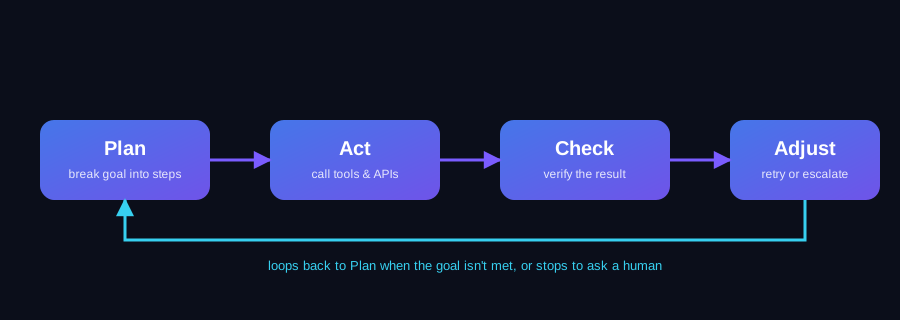
A route optimization model takes live inputs (traffic, delivery windows, vehicle capacity, fuel cost, and driver hours) and continuously re-solves for the lowest-cost route across the fleet, not just one vehicle at a time. The differentiator versus a basic mapping tool is that it replans mid-route: when a shipment is delayed, a customer reschedules, or a road closes, the system re-optimizes the remaining stops automatically instead of waiting for a dispatcher to notice and manually reroute. That's the same plan-act-check-adjust loop behind agentic AI applied specifically to fleet dispatch.
What About Demand Forecasting for GCC Supply Chains?
- Forecasting models combine historical order data with seasonal patterns: Ramadan, National Day, back-to-school, and summer slowdowns move volume differently across GCC markets than a generic global template assumes.
- Accurate demand forecasts let warehouses hold less buffer stock without running out, and let fleet planners size trucks and shifts to actual expected volume instead of worst-case guessing.
- The same forecasting layer feeds route optimization: knowing tomorrow's likely order volume by zone lets the system pre-plan efficient routes instead of reacting cold each morning.
What Do Results Look Like in Practice?
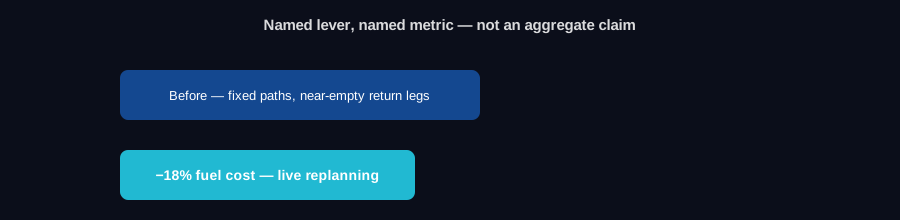
In one BounceTech logistics engagement, route optimization AI cut fleet fuel costs by 18%. The saving came almost entirely from eliminating redundant mileage: routes that used to run near-empty return legs or take a fixed path regardless of live traffic were replanned continuously instead. That's a realistic, single-lever result. Vendors who promise a blanket "30-50% cost reduction across the board" without naming which lever moved are usually rounding up a best case, not reporting a typical one.
Route optimization AI doesn't replace the dispatcher's judgment. It removes the part of the job that's just re-solving arithmetic every time a road closes.
What Should You Look for in a Logistics AI Partner in the UAE?
Global logistics performance is tracked over time through indices such as the World Bank's Logistics Performance Index, and GCC governments have been investing heavily in ports, customs digitization, and last-mile infrastructure to move up that ranking. That means the fleets and warehouses layered on top of that infrastructure are under real pressure to modernize too. When evaluating a partner, ask whether their route optimization replans mid-route automatically or only at planning time, whether their demand forecasts account for regional seasonal events rather than a generic calendar, and whether they can point to a specific, attributable metric (like a fuel-cost or on-time-delivery percentage) from a comparable deployment, not just an aggregate industry claim. Route optimization and demand forecasting also pair well with broader intelligent automation and a solid data engineering layer underneath, since forecast accuracy is only as good as the order and telematics data feeding it.
Frequently asked questions
How does AI route optimization work for logistics fleets?
It takes live inputs (traffic, delivery windows, vehicle capacity, fuel cost, driver hours) and continuously re-solves the lowest-cost route across the whole fleet, automatically replanning when a shipment is delayed or a road closes instead of waiting for manual dispatcher intervention.
What kind of fuel savings can AI route optimization deliver?
Results vary by fleet and route structure, but in one BounceTech logistics engagement, route optimization AI reduced fleet fuel costs by 18%, primarily by eliminating redundant mileage from routes that didn't account for live traffic conditions.
Does demand forecasting need to be GCC-specific, or can a generic model work?
It needs to be region-specific. Ramadan, National Day, and summer slowdowns shift order volume differently across GCC markets than a generic global seasonal template, and a forecast built on the wrong calendar will misguide both inventory and fleet sizing.
What should I ask a logistics AI vendor before signing in the UAE?
Ask whether route optimization replans automatically mid-route or only at planning time, whether demand forecasts account for regional seasonal events, and whether they can show a specific, named metric from a comparable deployment rather than an aggregate industry-wide claim.
Does AI route optimization replace dispatchers?
No. It removes the part of the job that's just re-solving arithmetic every time a road closes or a shipment is delayed. Dispatcher judgment still matters for exceptions and customer-specific calls; the AI handles the continuous mid-route recalculation.
Want this built for your team?
We ship production-grade AI like this across every industry, in weeks, not months.