
What Is Agentic AI? A 2026 Guide for UAE Enterprises
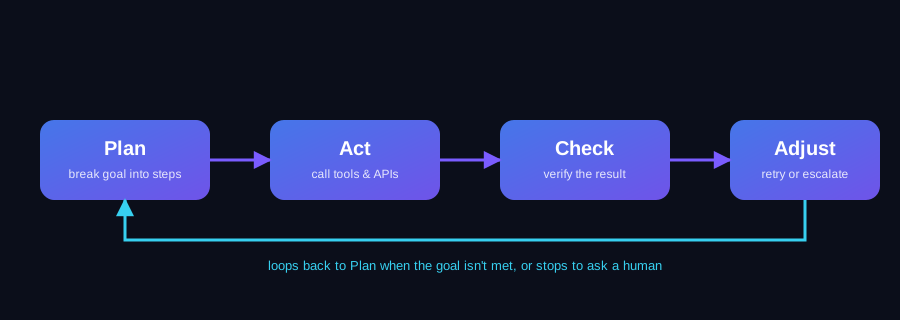
Agentic AI is a system that plans a multi-step task, takes actions through tools and APIs, checks its own results, and adjusts, all without a human prompting every step. Where a chatbot answers one question at a time, an agent pursues a goal: raise a purchase order, reconcile an invoice, triage a support ticket, and only escalate when it hits a decision it isn't authorized to make.
 By: Asad Siddiq
What agentic AI actually means
Most "AI" enterprises have deployed so far is single-turn: a model reads an input and produces an output (a summary, a classification, a drafted reply). Agentic AI adds three things on top: a plan (break a goal into steps), tool use (call APIs, query databases, fill forms), and a feedback loop (check whether the last action worked before taking the next one). That loop is the entire difference. It's why an agent can be handed "process this vendor invoice" instead of "summarize this vendor invoice."
How it differs from chatbots and RPA
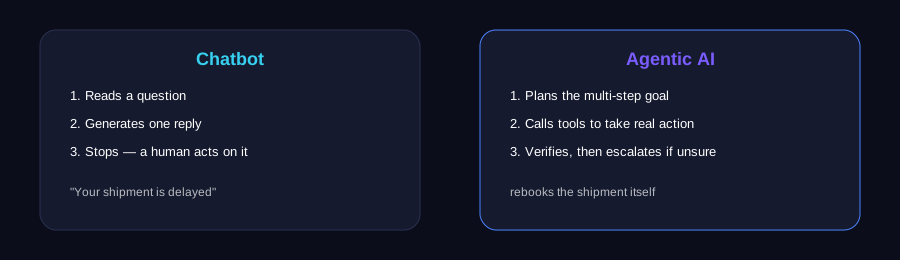
- A chatbot answers; an agent acts. A chatbot can tell a customer their shipment is delayed. An agent can rebook the shipment.
- RPA follows a fixed script and breaks the moment a screen or field changes. An agent reasons about the current state and adapts the path to the goal.
- Chatbots are stateless per turn. Agents hold a working plan across many steps and can retry, branch, or ask a human when confidence is low.
Why UAE enterprises are moving now
The UAE's national posture on AI isn't incidental to this shift. The UAE Strategy for Artificial Intelligence commits the country to AI leadership by 2031, and that's pulled adoption forward across banking, government services, and logistics faster than most regions. Globally, Gartner projects that 40% of enterprise applications will feature task-specific AI agents by 2026, up from under 5% in 2025. The shift isn't experimental anymore, it's a procurement line item.
Where agentic AI creates real value
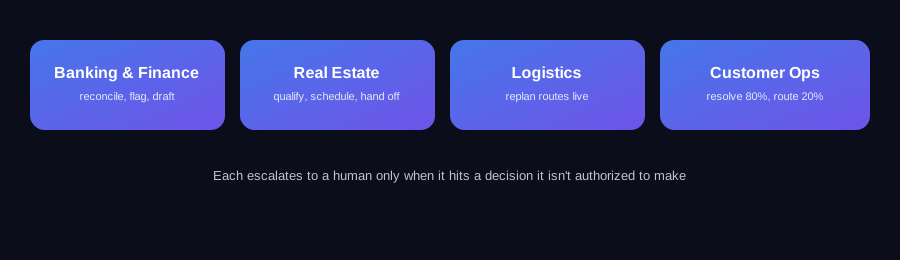
- Banking & finance: an agent reconciles transactions, flags anomalies, and drafts the compliance note, escalating only the cases a human must sign off on.
- Real estate: an agent qualifies inbound leads, checks unit availability, schedules viewings, and hands a warm, context-complete lead to a sales agent. See our AI use cases for Dubai developers.
- Logistics: an agent replans a delivery route the moment a shipment is delayed, without waiting for a dispatcher to notice. See our logistics route optimization guide.
- Customer operations: an agent resolves the routine 80% of tickets end to end and routes the remaining 20% with full context attached, not a blank handoff.
The risk enterprises underestimate
Agentic AI fails differently than a chatbot. A bad chatbot answer is a bad sentence; a bad agent action is a wrong purchase order, a duplicate refund, or a message sent to the wrong customer. Gartner's own research warns that over 40% of agentic AI projects will be cancelled by end of 2027, largely from teams that skipped scoping, cost control, and governance and shipped an agent with no guardrails. The fix isn't avoiding agents. It's building the same discipline you'd expect from any system that takes real actions: scoped permissions, a human-in-the-loop for anything irreversible or above a cost threshold, and full logging of every action an agent takes.
The question isn't whether an agent can do the task. It's whether you can prove, after the fact, exactly why it did what it did.
How to evaluate an agentic AI partner in the UAE
Ask three things before signing: Can they name the exact tools and systems the agent will call, and the permission boundary around each? What happens when the agent is uncertain? Does it guess, or does it stop and ask? And can they show you the audit trail for a single agent run, end to end, on request? A partner who can't answer all three isn't ready to put an agent in front of your customers or your ledger. This is also where generative AI and LLM foundations matter. An agent is only as reliable as the model and retrieval layer underneath it. See our companion piece on RAG that survives production for how that grounding actually gets built.
Frequently asked questions
What is agentic AI in simple terms?
Agentic AI is software that plans a multi-step goal, takes real actions through tools and APIs, checks whether those actions worked, and adjusts, instead of just answering one question at a time.
How is agentic AI different from a chatbot?
A chatbot answers a question in one turn. An agent pursues a goal across many steps, calling real tools and systems, and only stops to ask a human when it hits a decision it isn't authorized to make.
Is agentic AI safe for enterprise use?
It's safe when scoped: limited permissions per tool, mandatory human sign-off on irreversible or high-cost actions, and a full audit log of every action taken. Without those guardrails, Gartner expects over 40% of agentic AI projects to be cancelled by 2027.
Which UAE industries are adopting agentic AI first?
Banking and finance (reconciliation, fraud triage), real estate (lead qualification), logistics (route replanning), and customer operations are moving fastest, alongside the UAE's national push toward AI leadership by 2031.
What questions should I ask an agentic AI vendor before signing?
Ask them to name the exact tools and systems the agent will call and the permission boundary around each, what happens when the agent is uncertain, and whether they can show a full audit trail for a single agent run on request. A vendor who can't answer all three isn't ready.
Want this built for your team?
We ship production-grade AI like this across every industry, in weeks, not months.