How to Choose an AI Development Company in the UAE: 9-Point Checklist
Most AI vendor decks look the same. The difference between a partner who ships production AI and one who ships a demo shows up in nine specific, checkable things, not in how polished the pitch is. This guide walks through each check in depth, why regional experience outweighs brand size, and the fastest way to test a vendor before committing budget.
 By: Asad Siddiq
The UAE AI market is crowded with vendors who can demo well and ship poorly. Before signing an AI consulting engagement, run every candidate through the same nine checks. They separate a partner who's actually built production systems in the region from one who's selling a platform.
1. Can They Name the Exact Tools and Systems the AI Will Call?
A vendor who can't specify the exact APIs, databases, and systems their solution integrates with hasn't scoped your project yet; they're selling a generic capability, not a plan.
Why This Is the First Thing to Check
Every real AI project touches specific systems: a CRM, a document store, a legacy database, a third-party API. A vendor who answers this question with a platform name instead of your actual systems is describing what they sell, not what they'll build for you. Push past the platform pitch to the integration specifics before anything else.
2. Do They Handle Native Arabic, or Just Translation?
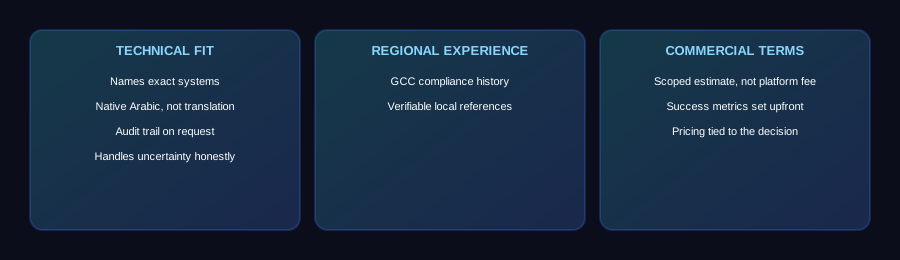
Ask specifically how their system handles Arabic dialect and code-switched Arabic-English queries, common in UAE customer interactions. A translation layer bolted onto an English-first model is a different, weaker product than native Arabic NLP.
The Question That Separates the Two Approaches
Ask for a live demo using a real, messy example: a customer message that mixes Arabic and English in the same sentence, the way people actually write. A translation-layer system stumbles on this immediately. Native Arabic NLP handles it as a normal case, not an edge case.
3. Can They Show an Audit Trail for a Single AI Decision?
Ask for an end-to-end trace of one decision: what data went in, what the model considered, what it output, and why. A vendor who can produce this on request has built for accountability. A vendor who can't is asking you to trust a black box with your customers or your ledger.
4. What Happens When the Model Is Uncertain?
Every model encounters inputs it's not confident about. The question is whether it guesses anyway, presenting a wrong answer with the same confidence as a right one, or whether it recognizes uncertainty and either abstains or escalates to a human. This single behavior predicts more about production reliability than almost any other spec.
- 5. Do they have GCC-specific compliance and data residency experience?
- 6. Can they quote a scoped estimate tied to one specific use case, not a platform-wide number?
- 7. Will they name real, verifiable technical references, not just logos on a slide?
- 8. Do they define success metrics before the project starts, not after?
- 9. Is their pricing scoped to the decision the AI needs to make, or to hours billed?
Why Checks 5 Through 9 Matter Just as Much
Data residency and compliance experience protects you from a costly rebuild when a regulator asks a question the vendor never anticipated. A scoped estimate tied to a specific use case is the single best predictor of whether a project stays on budget. Platform-wide pricing almost always balloons once real scope surfaces. And a vendor who won't define success metrics upfront is leaving themselves room to declare victory regardless of outcome.
Why Does Regional Experience Matter More Than Global Brand Recognition?
A global vendor's case studies from the US or Europe don't tell you how their system handles UAE compliance requirements, Arabic-language data, or GCC business culture. Regional specificity, not brand size, is what predicts whether a system actually ships and holds up in production here.
What 'Regional Experience' Should Actually Mean
It's not enough for a vendor to have an office in Dubai. Ask what GCC-specific regulatory frameworks they've built against, how many of their production deployments are actually live in the region today, and whether their technical team has hands-on experience with Arabic-language data specifically; not just localized marketing copy.
A partner who can't answer all nine isn't ready to put an AI system in front of your customers or your ledger.
What Red Flags Mean You Should Walk Away?
Beyond failing the nine checks above, a handful of behaviors during the sales process itself predict trouble later.
Pressure to Sign Before Scoping
A vendor pushing for a signed contract before they've asked detailed questions about your specific systems and data hasn't scoped anything, they're selling urgency, not a plan. Real scoping takes time and involves real questions about your environment.

Vague Answers on Data Ownership and Portability
Ask explicitly what happens to your data and any trained models if you end the engagement. A vendor who can't give a clear, specific answer is leaving room to lock you in, which is a commercial risk as real as any technical one.
No Willingness to Start Small
A vendor confident in their own work should welcome a small, provable pilot as the fastest way to earn a larger engagement. Resistance to starting small is usually a sign the vendor knows a narrow pilot wouldn't hold up to scrutiny.
What's the Fastest Way to Test a Vendor Before Committing?
Scope a single narrow pilot, one decision, one dataset, one measurable outcome, before any multi-system commitment. A vendor who resists scoping down to something small and provable is telling you something about how the rest of the engagement will go.
What a Good Pilot Scope Looks Like
A well-scoped pilot has a single, measurable success metric agreed before it starts, uses real (not synthetic) data from your environment, and has a fixed timeline short enough to evaluate without a large sunk cost. If a vendor's proposed pilot doesn't have all three, that's worth pushing back on before signing anything larger.
How Should You Structure the First Conversation With a Shortlisted Vendor?
The first call sets the tone for everything after it; treat it as a working session, not a pitch you passively sit through.
Come With Your Own Use Case, Not a Blank Slate
Walk in with a specific decision or workflow you want AI to touch, along with whatever data or systems are involved. A vendor's response to a concrete use case reveals far more about their actual capability than their response to an open-ended 'what can you do for us' question.
Ask Them to Push Back
A vendor who agrees with every idea you propose, including the ones that don't make technical sense, isn't giving you an honest read. Ask directly: 'what would you push back on in this plan?' A partner worth hiring has an opinion and will share it, even in a first call.
Leave With a Written Scope, Not Just a Good Feeling
Before ending the call, ask for a written summary of what was discussed, the use case, the data involved, and a rough scope. A vendor who can't produce that within a day or two hasn't actually understood the conversation well enough to act on it.
What Should You Expect to Pay, and How Should It Be Structured?
Pricing in the UAE AI market varies widely, and the structure of the quote often tells you as much as the number itself.
Scoped-Engagement Pricing vs. Platform Subscription
A vendor quoting a scoped estimate tied to your specific use case, data volume, integration complexity, success criteria, is pricing your actual project. A vendor quoting a flat platform subscription before understanding your use case is pricing a generic product and hoping it fits. The first is far more likely to reflect real costs and avoid scope surprises later.
What a Fair Payment Structure Looks Like
Milestone-based payment tied to pilot success, followed by a separate scope and quote for expansion, protects you from paying for a platform-wide commitment before the first narrow use case has proven out. A vendor unwilling to structure payment this way is asking you to take on all the risk upfront.
Frequently asked questions
What questions should I ask before hiring an AI company in Dubai?
Ask them to name the exact systems they'll integrate with, how they handle native Arabic (not just translation), whether they can show an audit trail for a single decision, and whether pricing is scoped to your specific use case.
How do I know if an AI vendor has real UAE experience or just a global template?
Ask for regional, verifiable technical references, not logos on a slide, and specific detail on how they've handled GCC compliance and data residency requirements before, not in theory.
Should I sign a full AI platform contract or start with a pilot?
Start with a single narrow, measurable pilot, one decision, one dataset, one outcome, before any multi-system commitment. A vendor who resists scoping down is a signal worth noting.
Why does Arabic-language handling matter when choosing an AI vendor in the UAE?
UAE customer interactions routinely mix Arabic dialect and English in the same message. A system built only for translated or Modern Standard Arabic will misread real customer queries.
What's a red flag when evaluating an AI development company?
A vendor who can't name the exact tools and systems involved, can't explain what happens when the model is uncertain, or quotes a platform-wide number instead of a scoped estimate for your specific use case.
Want this built for your team?
We ship production-grade AI like this across every industry, in weeks, not months.