
Legal AI in the UAE: What It Actually Does and Where a Lawyer Still Has To
Legal AI in the UAE today reads contracts, researches case law and precedent, and watches for regulatory changes, all faster than a team can do it manually. It does not decide how a disputed matter should be argued, what a client's real risk appetite is, or whose name goes on the advice. That line, not a vague promise of 'AI for lawyers,' is what a UAE firm or in-house team actually needs to evaluate before adopting it.
 By: Asad Siddiq
Every legal AI pitch in the UAE claims to save lawyers hours. Few say exactly which hours, and fewer still say which parts of the job the tool cannot touch. That gap is where budgets get wasted on the wrong tool, or worse, where a firm quietly lets a tool make a call it was never built to make. What follows draws the line: what legal AI reliably does today, what it does not replace, and the UAE-specific considerations, Arabic documents and the DIFC/ADGM common-law split, that change how it should be built here.
What Does Legal AI Actually Do for a UAE Law Firm or In-House Team?
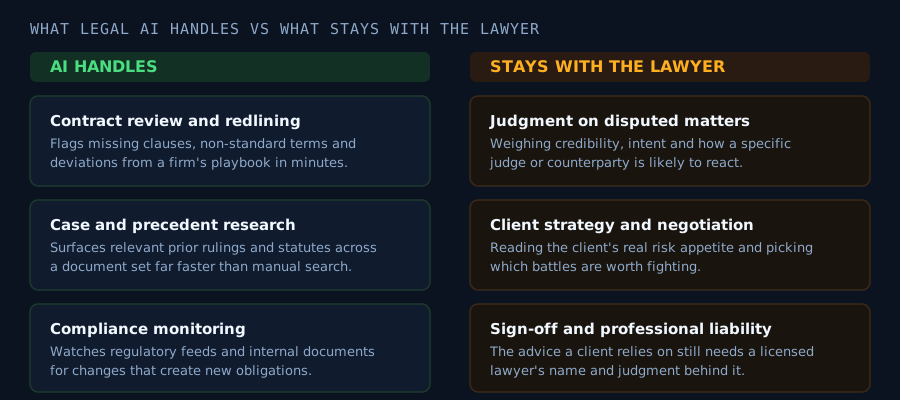
Three use cases account for most of the real, working legal AI in production today: contract review, case and precedent research, and compliance monitoring. Each is a narrow, well-defined task with a clear right answer to check the output against, which is exactly why AI performs well on them and poorly on tasks without one.
Contract Review and Redlining
Contract review is the most mature legal AI use case anywhere, and the numbers back that up. Thomson Reuters' 2026 AI in Professional Services report found 77% of legal professionals already use GenAI for document review, more than any other use case, with 58% using it to draft contracts directly. A tool reads a contract against a firm's playbook or a set of house standards, flags missing clauses, non-standard terms and clauses that deviate from precedent, and proposes a redline. A lawyer still decides which flags matter and which redline to send.

Case and Precedent Research
Legal research sits just behind document review in adoption, at 74% according to the same Thomson Reuters data. A research tool searches case law, statutes and prior filings and surfaces the passages relevant to a specific question, in a fraction of the time a manual search across databases takes. What it returns is a shortlist of relevant material, not a verdict on which precedent wins the argument. Every citation still needs a lawyer to confirm it actually says what the tool claims before it goes in a filing.
Compliance Monitoring
The third real use case is ongoing, not one-off: watching regulatory feeds, internal policies and existing contracts for a change that creates a new obligation. A UAE compliance team tracking central bank circulars, data protection updates or sector-specific rules across dozens of contracts cannot do that manually at scale without something falling through. AI does the watching. A compliance officer still decides what the flagged change actually requires the business to do.
What Can't Legal AI Replace in a UAE Firm?
Judgment on Disputed Matters
Contract review and research both have a checkable output: did the tool find the clause, did it surface the right case. A disputed matter does not. Whether a specific judge, arbitrator or counterparty is likely to respond to an argument, how much weight a fact carries against a competing fact, and which battle is worth fighting are judgment calls with no ground truth to check the model against. Treating an AI output as the answer here, instead of an input to a lawyer's judgment, is where legal AI adoption actually goes wrong.
Client Relationship, Strategy and Sign-Off
A client's real risk appetite rarely matches what is written in a brief. Reading that, and deciding what to advise given it, is relationship work a model has no access to. And regardless of how good the drafting or research behind it is, the advice a client relies on and the filing a court receives still needs a licensed lawyer's name and professional judgment behind it. That accountability does not transfer to a tool, in the UAE or anywhere else.
How Does Legal AI Handle Arabic Legal Documents in the UAE?
Most UAE legal AI tools sold as 'multilingual' are running an English-trained model through a translation layer, and it shows on real documents. Arabic legal drafting uses formal structures, defined-term conventions and phrasing that a general-purpose translator flattens or misreads, and a mistranslated clause in a reviewed contract is a worse outcome than no review at all. A tool built for UAE legal work needs to read and reason over Arabic contracts and filings natively, not translate them into English and reason there, the same distinction that separates a working Arabic support system from one that quietly fails on real usage.

Does DIFC and ADGM Common Law Change How Legal AI Should Be Built?
Yes, and this is the UAE-specific detail most legal AI vendors skip. The DIFC Courts sit inside Dubai but have jurisdiction over civil and commercial matters only, operating as an English-language court system separate from onshore Dubai courts. ADGM in Abu Dhabi goes further, applying English common law directly as its legal framework, the only jurisdiction in the region to do so, while onshore UAE courts across the rest of the country apply a civil-law system rooted in codified statute. A contract-review tool tuned only on onshore civil-law drafting conventions will misread a DIFC or ADGM common-law contract's structure, and the reverse is just as true. A firm or in-house team operating across both needs the tool told which jurisdiction's conventions apply to which document, not one model treating every UAE contract the same way.
How Should a UAE Firm Evaluate a Legal AI Vendor?
- Ask for the accuracy claim broken down by task: contract review, research and compliance monitoring each have different failure profiles, and a single blended accuracy number hides which one is weak.
- Ask whether Arabic handling is native or translation-layer, and test it on an actual Arabic contract from your own files before signing, not a vendor demo document.
- Ask which jurisdiction's drafting conventions, onshore civil law or DIFC/ADGM common law, the tool was actually trained or tuned on.
- Ask where documents are processed and stored. Client files are commercially sensitive, and data residency rules out a real share of the hosted-model market for regulated matters.
- Ask what the escalation path is when the tool is uncertain: does it flag low confidence and route to a lawyer, or does it guess silently. The failure path matters more than the demo.
The same evaluation discipline applies whatever the tool: Thomson Reuters found 53% of legal professionals are already seeing measurable ROI from AI investment, and the gap between that group and the rest is rarely the model. It is whether the firm scoped the tool to a checkable task and kept a lawyer in the loop on everything else.
Frequently asked questions
What does legal AI actually do for a law firm today?
The three mature, working use cases are contract review and redlining, case and precedent research, and ongoing compliance monitoring. Each has a checkable right answer, which is why AI performs reliably on them. 77% of legal professionals already use GenAI for document review and 74% for legal research, according to Thomson Reuters' 2026 AI in Professional Services report.
Can legal AI replace a lawyer in the UAE?
No. It handles narrow, checkable tasks like flagging contract clauses or surfacing relevant case law. It cannot weigh judgment on a disputed matter, read a client's real risk appetite, or carry the professional accountability a licensed lawyer's sign-off requires. Those stay human regardless of how good the underlying model is.
Does legal AI work on Arabic legal documents?
Only if it is built to reason over Arabic natively. Many tools marketed as multilingual run an English-trained model through a translation layer, which misreads formal Arabic legal drafting structures and defined-term conventions. Test any vendor on an actual Arabic contract from your own files before signing, not their demo document.
How does DIFC and ADGM common law affect legal AI tools in the UAE?
DIFC Courts and ADGM both operate on English common-law principles, ADGM applying it directly as its legal framework, while onshore UAE courts apply a civil-law system built on codified statute. A contract-review tool tuned only on one jurisdiction's drafting conventions will misread documents drafted under the other, so ask a vendor which jurisdiction their tool was actually trained on.
What should I ask a legal AI vendor before signing?
Ask for accuracy broken down by task rather than one blended number, whether Arabic handling is native or translation-based, which jurisdiction's conventions the tool was tuned on, where documents are stored, and what happens when the tool is uncertain. That last answer, the escalation path, matters more than anything shown in a demo.
Want this built for your team?
We ship production-grade AI like this across every industry, in weeks, not months.