
Native Arabic NLP: Why Off-the-Shelf Chatbots Fail in the Gulf
Arabic NLP solutions in Dubai are usually sold as a feature checkbox: "Arabic supported." In practice, that almost always means a model trained on Modern Standard Arabic (MSA) news text, wrapped around a translation layer. It fails the moment a real customer writes in Gulf dialect, mixes in English words mid-sentence, or uploads a scanned Arabic contract. Native Arabic NLP is built differently from day one, for the dialects, scripts, and document formats GCC businesses actually use, and that difference shows up directly in deflection rates, customer trust, and compliance risk.
 By: Asad Siddiq
What Is Native Arabic NLP, and Why Does It Matter for GCC Businesses?
Native Arabic NLP means the language model, the retrieval pipeline, and the interface were designed around Arabic as a first-class language, not bolted on after an English-first product shipped. That distinction matters because Arabic isn't one language for NLP purposes. It's a family of related but distinct varieties: Modern Standard Arabic for formal writing, and regional dialects like Gulf/Khaleeji, Egyptian, and Levantine Arabic for everyday speech and chat. A model trained only on MSA news articles will misread a customer typing in Emirati or Saudi dialect the same way an English model trained only on legal filings would misread a text message.
Why Do Off-the-Shelf Chatbots Struggle with Arabic?
Four structural problems recur across generic deployments in the Gulf:
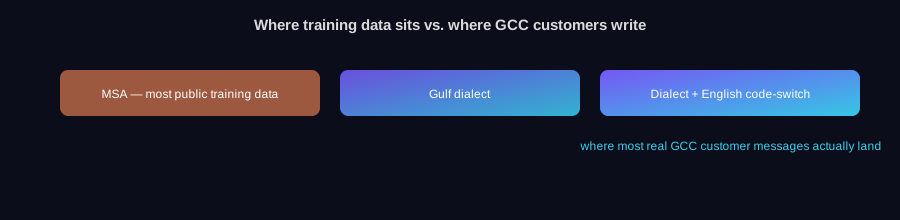
- Dialect gap: most public Arabic training data is MSA (news, government text), so models perform well on formal writing and poorly on the dialect customers actually type or say.
- Script and morphology: Arabic is written right-to-left, drops short vowels in normal writing, and a single root can generate dozens of word forms depending on prefixes and suffixes. Naive tokenizers built for Latin-script languages handle this badly.
- Code-switching: GCC customers routinely mix Arabic and English in one sentence ("ابغى أعمل book appointment"). Models tuned on monolingual data misclassify intent when the switch happens mid-query.
- Document intelligence: contracts, government forms, and invoices in the Gulf are frequently scanned Arabic PDFs with mixed fonts and handwriting. Generic OCR-plus-translate pipelines lose meaning and legal nuance in the translation step.
What Does "Native" Arabic NLP Actually Require?
A genuinely native Arabic NLP system is built on dialect-aware training and evaluation data, not just MSA corpora. That means it's tested against real Gulf-dialect conversation samples, not translated English test sets. It uses tokenization and retrieval built for Arabic morphology, so a RAG and knowledge-systems layer can actually match a customer's phrasing to the right clause in an Arabic-language policy document instead of missing it on a root-word mismatch. And it treats code-switching as the default case to design for, not an edge case to patch later, because in the Gulf, mixed Arabic-English input is the norm, not the exception.
Where Does This Matter Most for GCC Enterprises?
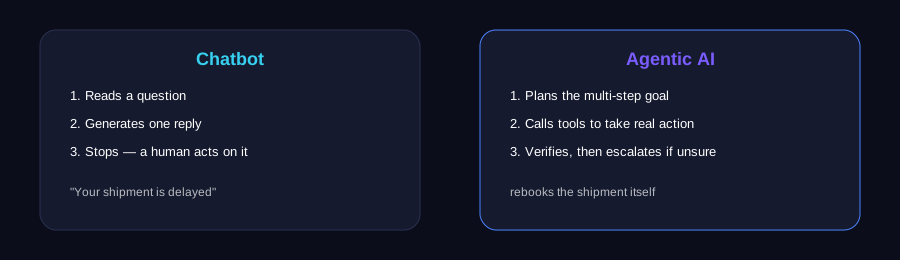
- Customer-facing chatbots and voice agents: an AI copilot or assistant that only performs well in MSA will frustrate the majority of customers who write or speak in dialect, directly hurting deflection rates and CSAT.
- Arabic document intelligence: banks, government-adjacent entities, and real estate firms in the Gulf process huge volumes of Arabic contracts, IDs, and forms; native NLP is what makes automated extraction and search over that content reliable instead of a liability.
- Voice AI in Arabic: accurate speech recognition for Gulf dialect is a harder problem than MSA transcription, and it's the layer most vendors quietly skip. This same dialect-first discipline is what separates a real machine learning build from a wrapper around a generic API.
Arabic isn't one language for a model to learn. It's a dialect continuum, and a chatbot that only speaks the news-anchor version of it isn't speaking your customers' language.
How Should You Evaluate an Arabic NLP Vendor in the UAE?
Arabic is spoken natively by hundreds of millions of people worldwide, yet by W3Techs' ongoing tracking of web content by language, Arabic still makes up only a small fraction of indexed web content. That means most publicly available training data skews heavily toward MSA and away from the dialect and code-switched text GCC businesses actually generate. That gap doesn't close on its own; it has to be engineered around. Before signing with a vendor, ask three things: can they show dialect-specific evaluation results (not just MSA benchmarks), how does their pipeline handle Arabic-English code-switching in a single query, and have they built Arabic document intelligence for real scanned contracts or forms, not a demo built on clean, born-digital PDFs. A vendor who can't answer with specifics is selling translation, not native Arabic NLP.
Frequently asked questions
What is native Arabic NLP?
Native Arabic NLP is a language system designed around Arabic from the start (dialect-aware training data, morphology-aware tokenization, and code-switching handling) rather than an English-first model with an Arabic translation layer bolted on.
Why do generic chatbots fail on Arabic in the Gulf?
Most public Arabic training data is Modern Standard Arabic (formal, written), while GCC customers speak and type in regional dialect and frequently mix in English mid-sentence. Generic chatbots trained only on MSA misread both patterns.
Does Arabic NLP need to handle English mixed in the same sentence?
Yes. Code-switching between Arabic and English within a single message is the normal pattern for GCC customers, not an edge case. A system that only handles pure Arabic or pure English will misclassify a large share of real queries.
How do I evaluate an Arabic NLP vendor before signing?
Ask for dialect-specific evaluation results (not just MSA benchmarks), how they handle Arabic-English code-switching, and whether they've built document intelligence on real scanned Arabic contracts or forms rather than clean, born-digital demo files.
Is Gulf dialect really that different from Modern Standard Arabic for an AI model?
Yes, different enough that a model trained only on MSA news text will frequently misread everyday Gulf/Khaleeji conversation the same way an English model trained only on legal filings would misread a casual text message. They share a written script but diverge significantly in vocabulary, phrasing, and structure.
Want this built for your team?
We ship production-grade AI like this across every industry, in weeks, not months.