
LLM Optimization Company in Dubai: What They Actually Do
LLM optimization is the work of making a large language model application cheaper, faster, or more accurate in production, without retraining the whole system from scratch. For most UAE enterprises running an LLM feature at real scale, cost and latency creep up quietly after launch, and an optimization company's job is to find where that's happening and fix it in the right order. This guide covers the four levers that actually move the number, what a specialist company does day to day, and how to evaluate one.
 By: Asad Siddiq
Teams that launch an LLM feature rarely optimize it before launch, there's no production traffic to optimize against yet. The work happens after, once real usage exposes where cost and latency actually accumulate. That's the gap an LLM optimization engagement fills.
What Does LLM Optimization Actually Mean?
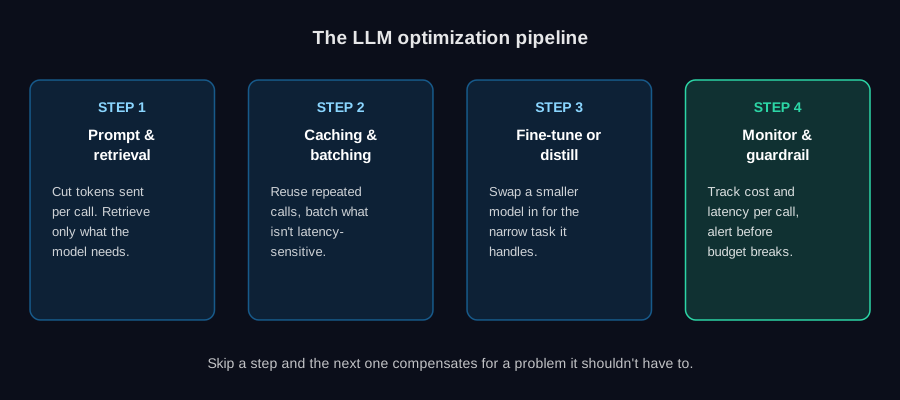
LLM optimization means reducing the cost or latency of a production LLM system, or improving its accuracy, without a full model retrain. It covers four distinct levers, prompt and retrieval design, caching and batching, fine-tuning or distillation, and ongoing production monitoring, and most real engagements touch all four in roughly that order.
1. How Does Prompt and Retrieval Optimization Cut Cost?
Every token sent to the model costs money and adds latency, and most production prompts carry far more context than the model actually needs for a given call. Trimming prompt templates, retrieving only the specific passages relevant to the query instead of whole documents, and removing redundant system instructions typically cuts token volume substantially before touching the model itself.
Why Retrieval Quality Matters More Than Retrieval Quantity
A retrieval step that pulls ten loosely-relevant passages costs more tokens and often produces worse answers than one that pulls three precisely-relevant ones. Tuning the retrieval step's relevance scoring, not just its result count, is usually the highest-leverage first move in an optimization engagement.
Where Prompt Bloat Quietly Accumulates
Prompt templates grow over months as teams patch edge cases with added instructions, and nobody goes back to remove what's no longer needed. A periodic prompt audit, not just a one-time cleanup at launch, is what keeps this from creeping back after the first optimization pass.
2. How Does Caching and Batching Reduce Latency and Spend?
A meaningful share of production LLM calls are near-duplicates, the same or very similar query asked repeatedly. Caching responses to common queries avoids paying for and waiting on a model call that's already been answered. Batching non-latency-sensitive calls (like overnight document processing) instead of running them one at a time in real time cuts cost further without affecting the user-facing experience.
What's Safe to Cache and What Isn't
Static or slow-changing queries, FAQ-style questions, standard document classifications, cache well. Anything involving live, fast-changing data or a personalized context shouldn't be cached without a short, explicit expiry, or customers start seeing stale answers presented as current.
Batching Without Hurting the User Experience
The rule is simple: batch anything the user isn't waiting on in real time. Overnight report generation, bulk document classification, and scheduled summarization all batch cleanly. Anything in a live chat or support flow needs to stay real-time regardless of the cost savings batching would offer.

3. When Does Fine-Tuning or Distillation Make Sense?
Fine-tuning or distilling a smaller model for one narrow, well-defined task usually costs less per call and runs faster than routing every request through a large general-purpose model, but it only pays off once a task's pattern is stable and well understood from production data. Reaching for fine-tuning before that data exists means fine-tuning against the wrong problem.
The Data Volume Question Most Teams Skip
Fine-tuning needs enough representative production examples to actually improve on the general-purpose model's baseline, not a handful of hand-picked samples. Teams that fine-tune too early, before enough real traffic has accumulated, often end up with a smaller model that performs worse than the general one it was meant to replace.
Distillation for High-Volume, Narrow Tasks
Distillation, training a smaller model to mimic a larger one's outputs on a specific task, works best for high-volume, narrow, repeatable calls: classification, extraction, routing. It's rarely worth the setup cost for a low-volume or highly variable task, where the general-purpose model's flexibility still earns its higher per-call cost.
4. How Do You Monitor Cost and Latency in Production?
Optimization isn't a one-time project, cost and latency drift as usage patterns shift, new features add new call paths, and the underlying model provider changes pricing or performance. Ongoing monitoring with alerting thresholds is what catches drift before it shows up as a surprise on next month's bill.
The Three Numbers Worth Tracking Per Call Path
Track cost per call, latency (p50 and p95, not just average), and token volume, broken out by the specific feature or call path generating them, not blended into one site-wide number. A blended average hides which specific feature is actually driving the spend.
Setting Alert Thresholds Before You Need Them
Set a cost-per-day or cost-per-feature alert threshold before launch, not after the first surprising invoice. A threshold that pages someone when spend crosses an expected range catches a runaway prompt or an unexpected traffic spike within hours, not at the end of the billing cycle.

Optimization isn't something you finish. It's something you keep monitoring, because the traffic pattern that made yesterday's setup efficient isn't the one you'll have next quarter.
What Does an LLM Optimization Company in Dubai Actually Do Day to Day?
A specialist engagement starts with an audit of your current production system, cost breakdown by feature, latency distribution, and prompt/retrieval review, before recommending which of the four levers to pull first.
The Audit Phase Comes Before Any Changes
Changing prompts or adding caching before understanding where cost and latency actually concentrate risks optimizing the wrong thing entirely. A real audit produces a cost-per-feature breakdown and a latency distribution before a single line of production code changes.
Implementation Is Usually Staged, Not All at Once
Prompt and retrieval tuning ships first since it's lowest-risk and fastest to validate. Caching and batching follow once the call patterns are well understood. Fine-tuning or distillation, if it's warranted at all, comes last, once enough production data exists to do it properly.
How Much Does LLM Optimization Cost, and What's the Realistic ROI?
Cost scopes to your current call volume and how much custom engineering the integration needs, not to a flat platform fee. A cost-benefit estimate run before scoping the engagement gives a realistic sense of where the savings will land before committing budget.
Where the Savings Typically Show Up First
Prompt and retrieval tuning alone often delivers the fastest visible cost reduction, sometimes within the first two to three weeks of an engagement, since it requires no infrastructure changes. Caching and batching compound on top of that over the following month as call patterns stabilize.
When the ROI Math Doesn't Favor Optimization Yet
A low-volume LLM feature, a handful of calls a day, rarely justifies a dedicated optimization engagement; the engineering cost exceeds the savings available. Optimization pays off once volume is high enough that a percentage cost reduction translates into a real dollar number worth the engineering time.
How Should You Evaluate an LLM Optimization Company in the UAE?
Ask for a cost-per-feature audit before any commitment, and ask which of the four levers they'd pull first and why, specific to your system, not a generic playbook answer. The same signals apply more broadly whenever you're shortlisting an AI partner, not just for LLM cost work: see our 10-signal vendor evaluation guide for the full checklist.
A Practical Evaluation Checklist
- Ask for a cost-per-feature and latency-distribution audit before any optimization work begins.
- Ask which lever they'd pull first on your system specifically, and why that one before the others.
- Confirm they'll set up ongoing monitoring and alert thresholds, not just a one-time optimization pass.
- Check whether they've handled a bilingual Arabic/English LLM system before, since caching and retrieval behave differently across languages.
Talk to us about auditing your current LLM cost and latency before scoping an engagement.
Frequently asked questions
What does an LLM optimization company actually do?
It audits a production LLM system's cost and latency by feature, then optimizes across four levers: prompt and retrieval tuning, caching and batching, fine-tuning or distillation, and ongoing monitoring, usually pulled in that order.
How much can LLM optimization actually save?
Savings scale with call volume and how much waste exists in the current prompt/retrieval design. Prompt and retrieval tuning alone often delivers the fastest visible reduction, with caching and batching compounding further over the following weeks.
Is fine-tuning always part of LLM optimization?
No. Fine-tuning or distillation only makes sense once a task's pattern is stable and enough production data exists to do it properly. Reaching for it before that data exists usually produces a smaller model that underperforms the general-purpose one.
Do I need LLM optimization if my usage volume is low?
Usually not yet. A low-volume feature rarely justifies the engineering cost of a dedicated optimization engagement; it pays off once volume is high enough that a percentage cost reduction becomes a real dollar number.
How is LLM optimization different from a full model retrain?
Optimization works within the existing model and system, tuning prompts, retrieval, caching, and monitoring, without retraining. Fine-tuning or distillation is the one lever that touches the model itself, and it's applied narrowly, not as a full retrain.
What should I ask an LLM optimization vendor before hiring them?
Ask for a cost-per-feature and latency audit before any commitment, which lever they'd pull first on your system and why, and whether they'll set up ongoing monitoring rather than a one-time pass.
Want this built for your team?
We ship production-grade AI like this across every industry, in weeks, not months.