
Government Automation Solutions in the UAE: What Actually Ships
Government automation in the UAE is not one platform a department buys. It is a set of narrow systems, each removing one bottleneck from one service: a permit application that waits for a person to read it, a citizen enquiry that sits in a call queue, a form whose details get re-keyed into three systems that do not talk to each other. The entities getting results pick one service, automate the part that needs no judgement, and keep a person on the part that does. This is what that looks like end to end, and what to check before scoping it.
 By: Asad Siddiq
The national direction is already set. In May 2026 the UAE Cabinet approved a framework to move 50% of government services and operations to agentic AI within two years, alongside a training programme covering 80,000 federal employees. That follows the UAE Strategy for Artificial Intelligence, which commits the country to AI leadership by 2031. For an individual entity, the question is no longer whether to automate. It is which service to start with, and how to build it so it survives an audit.
What Do Government Automation Solutions Actually Cover in the UAE?
Three categories cover almost every public-sector deployment we see in the UAE: citizen-facing service handling, document and case processing, and staff-facing knowledge access. Most entities assume the first is the priority because it is the most visible. In practice the second usually carries more hidden cost, because it consumes staff hours that never show up in a service-level report.
Citizen-facing service handling
A citizen service assistant answers enquiries and books appointments in Arabic and English, around the clock, covering the questions that make up most of a call centre's volume: what documents are required, what stage an application has reached, what the fee is, when the office is open. It does not replace the counter. It removes the repeat traffic so the counter can handle the cases that genuinely need a person. Our AI copilots and assistants work in public-sector settings is almost always scoped this way first.
Document and case processing
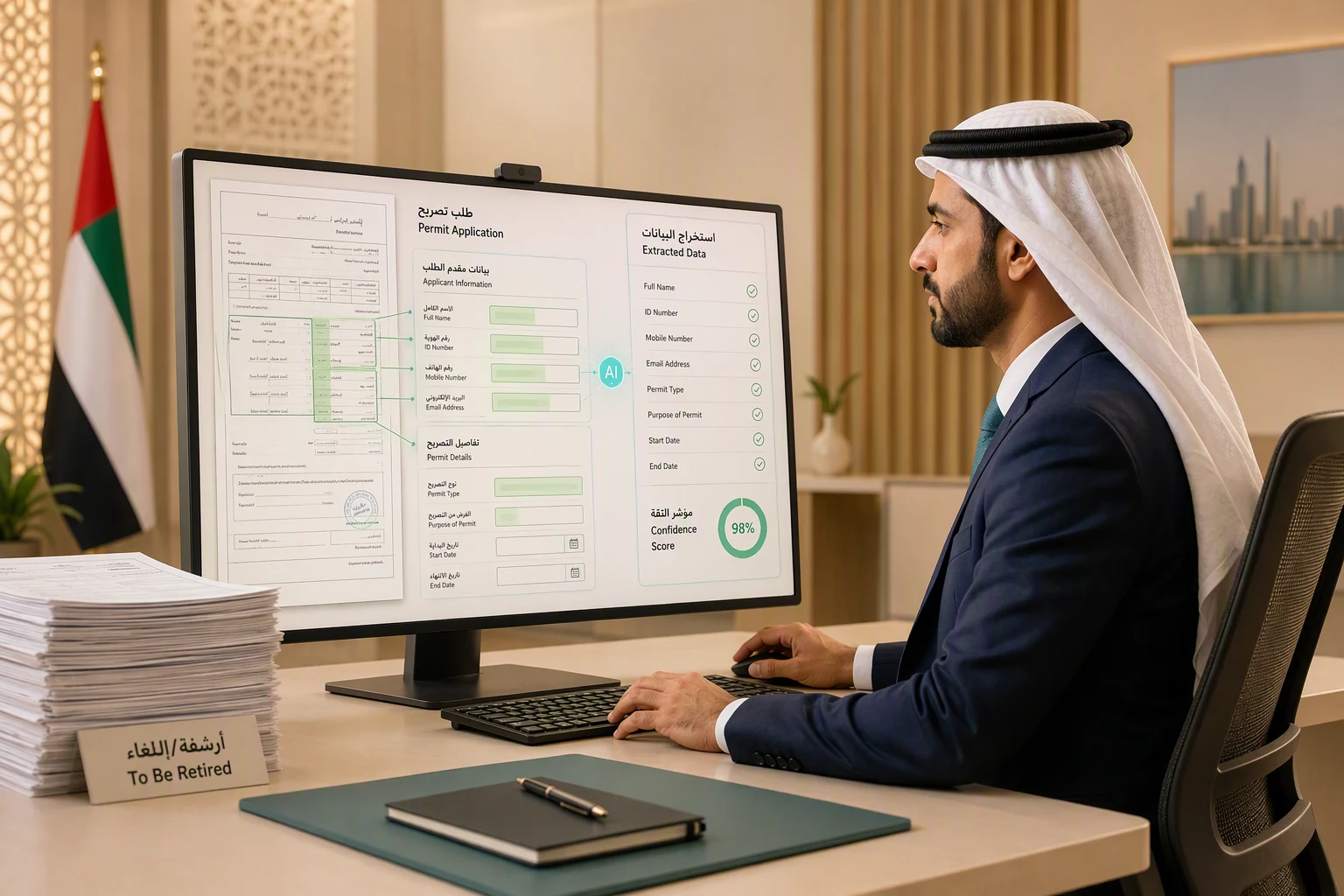
This is permits, licences, applications, renewals, and the supporting documents attached to each one. The work is reading, checking against records, deciding whether it meets policy, and routing it onward. Automating it means the system extracts and validates the details, then routes clean cases straight through and flagged cases to a named review queue. This is where intelligent automation earns its keep in government, because volume is high and most cases are unremarkable.
Staff-facing knowledge and policy search
Staff spend real time hunting through circulars, policy documents, and procedure manuals to answer one question correctly. A retrieval system grounded in your own policies returns the answer with a citation to the source clause, so the officer can verify it rather than trust it. A RAG and knowledge system built on internal documents is the least glamorous of the three and often the fastest to deploy, because it changes nothing about the underlying process.
Which Public-Sector Workflow Should You Automate First?
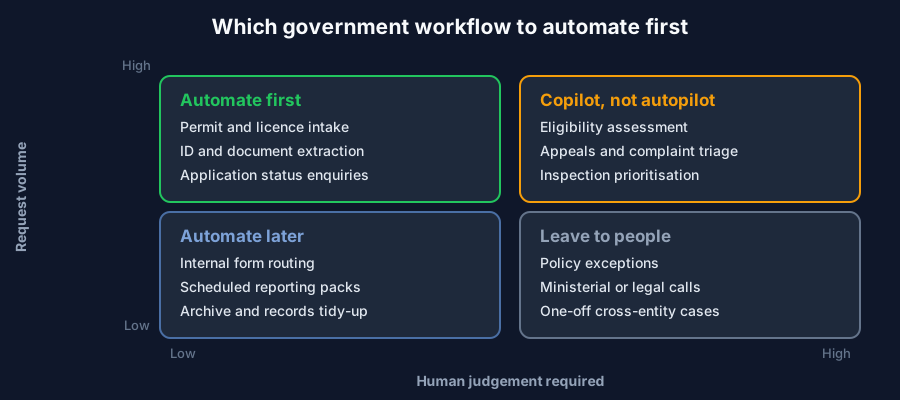
Score every candidate workflow on two axes: how much volume it carries, and how much human judgement each case genuinely requires. Those two numbers decide the order of work, and they are the reason so many public-sector AI projects stall. Entities usually pick the workflow that demos well rather than the one that carries the load.
The volume-versus-judgement matrix
High volume plus low judgement is where automation belongs first, because the same decision repeats thousands of times and the rules are already written down. High volume plus high judgement is copilot territory: the system prepares the case and a person decides. Low volume plus high judgement is not an automation problem at all, and treating it as one is how a programme loses credibility in its first quarter.
What automate-first looks like in practice
Permit and licence intake, identity and document extraction, and application status enquiries sit in the top-left quadrant for nearly every entity we have scoped. The rules are documented, the input is repetitive, and the cost is measured in staff hours rather than risk. Starting here means the first measurable result arrives while the programme still has attention on it.
The workflows to leave to people
Policy exceptions, decisions with legal or ministerial weight, and one-off cases that cross entity boundaries should stay with staff. Automating them produces a system nobody trusts and an escalation queue longer than the original backlog. Naming these explicitly at scoping time is worth more than it sounds, because it is the commitment that makes the rest of the programme credible internally.
How Does Government Document Automation Work End to End?
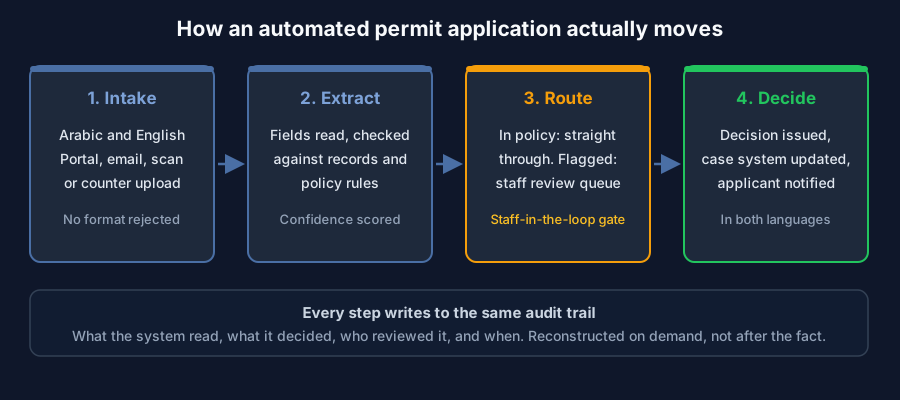
Four stages: intake, extraction and validation, routing, and decision with logging. The detail that matters is not any single stage. It is that a person sits inside the third stage by design, and that all four stages write to the same audit trail while they run.
Intake without rejecting formats
Applications arrive through the portal, by email, as a counter upload, and as a phone photograph of a printed form. A system that only accepts clean PDFs pushes the messy cases straight back to the staff it was meant to relieve. Intake has to accept Arabic and English, scanned and digital, structured and not, and normalise them into one queue.
Extraction and validation against policy
The system reads the fields, checks them against records it can reach, and tests them against the policy rules that already govern the decision. Each extracted field carries a confidence score. That score is what makes the next stage possible, because it separates the cases the system is sure about from the ones it is not.
Routing and the staff-in-the-loop gate
Cases that pass policy checks with high confidence route straight through. Anything below threshold, anything with a mismatch against records, and anything in a category flagged as sensitive lands in a staff review queue with the reason attached. The officer sees what triggered the flag rather than starting the review from scratch, which is the difference between a review queue that speeds work up and one that duplicates it.
Decision, notification, and the audit trail
The decision is issued, the case system is updated, and the applicant is notified in the language they applied in. Every step has already written its own record: what the system read, what it decided, what confidence it had, who reviewed it, and when. Audit readiness is a property of how the pipeline runs, not a report someone assembles afterwards.
Why Does Arabic-First Design Change the Result?
Because government documents in the UAE are Arabic documents, and a translation layer is not the same thing as an Arabic model. This is the single most common technical gap we find when reviewing a public-sector AI proposal, and it is usually invisible in a demo built on English sample data.
Translation pipelines lose the document
Scanned Arabic forms carry mixed fonts, handwriting, official stamps, and right-to-left layout. A pipeline that runs OCR, translates to English, then extracts fields is making three lossy guesses in a row, and the loss compounds on exactly the documents that matter most: identity papers, official correspondence, and stamped approvals. Native Arabic NLP means models trained on Arabic layouts and formatting directly, so extraction accuracy on Arabic documents matches what the same system achieves on English ones.
Citizen communication in both languages
The same gap shows up on the citizen-facing side. An assistant that answers fluently in English and awkwardly in Arabic pushes Arabic-speaking residents back to the phone line, which removes most of the benefit the project was funded for. Both languages need to be first-class from the first release, not sequenced as a phase two.
What Do UAE Data Residency and Compliance Actually Require?
Two questions decide the architecture: where the data is processed and stored, and what an auditor will expect to see afterwards. Both should be settled in writing before build starts, because retrofitting either one is expensive and sometimes impossible.
Where the data sits
Personal data handling in the UAE falls under Federal Decree-Law No. 45 of 2021 on the Protection of Personal Data, and most government entities carry their own residency policy on top of it. In practice that means the pipeline runs on-premise or in a UAE-hosted private cloud, with encryption and access control scoped per department. Confirm which model applies to your entity before evaluating vendors, because it eliminates a large part of the market immediately and saves the evaluation time.
What an audit expects to see
An auditor asks what the system decided, on what basis, and who was accountable. That requires a record written at the time of each decision, not reconstructed later from logs that were never designed for the question. Automated checks and audit-ready trails are part of the design brief for government and public sector AI, which is why the audit band in the flow above spans all four stages rather than sitting at the end.
Audit readiness is not a document you produce after the fact. It is a property of how the system runs while nobody is watching.

Do You Need a Sovereign AI Programme to Start?
No. Sovereign-scale AI infrastructure and a single department automating its permit queue are different projects with different budgets, timelines, and risk profiles. Conflating them is the most common reason a mid-market entity concludes that AI is not for them yet.
What a mid-market entity can ship in a quarter
One service, one department, one measurable outcome. Document extraction on a single permit type, or a citizen assistant covering the top twenty enquiry categories, is a scope that fits inside a quarter and produces a number you can put in front of leadership. Dubai's own paperless strategy reached its results this way, entity by entity, and the published figures are 336 million sheets of paper and 13 million man-hours of productivity removed from government transactions annually.
How the first deployment pays for the second
The integrations, the residency architecture, the audit logging, and the Arabic document models built for the first service are the same components the second service needs. That is why the second deployment is consistently faster and cheaper than the first, and why scoping the first one narrowly is a cost decision rather than a caution.
How Do You Measure Whether It Worked?
Baseline four numbers before anything is automated, then track the same four after. Entities that skip this step end up arguing about whether the system helped, which is an argument nobody wins.
The four numbers to baseline first
End-to-end turnaround time for the service, current backlog size, share of cases that need rework or resubmission, and staff hours spent on the workflow per week. All four are measurable from existing case-management data, and all four are what leadership will ask about at the first review.
What to monitor after go-live
Extraction accuracy and routing accuracy in production, with a named owner and a defined threshold that triggers retraining. Accuracy measured once during acceptance testing tells you nothing about month six, because the document mix changes as policy changes. Monitoring is where a deployment either holds its value or quietly loses it.
What Is the Bottom Line for UAE Government Entities?
Pick one service. Automate the part that needs no judgement, keep a person on the part that does, build Arabic in natively, settle residency before build, and log every decision as it happens. That sequence produces a working system inside a quarter and a foundation the next service reuses.
The entities that struggle are the ones that scope a department-wide transformation, discover the integration and residency work halfway through, and lose sponsorship before anything reaches a citizen. Narrow scope is not a lack of ambition. It is what makes the ambition survive contact with the case system.
Frequently asked questions
What are government automation solutions in the UAE?
They are narrow AI systems that remove manual steps from a specific public service: document and permit processing, citizen service assistants in Arabic and English, automatic case routing between departments, and policy search grounded in an entity's own documents. Each one is scoped to a single service rather than a department-wide platform.
How does government document automation work?
In four stages. Intake accepts Arabic and English documents in any format and normalises them into one queue. Extraction reads the fields, validates them against records and policy rules, and scores its confidence. Routing sends clean cases straight through and flagged cases to a staff review queue with the reason attached. The decision is then issued, the case system updated, and the applicant notified, with every step writing to the same audit trail as it happens.
Do UAE government entities need a sovereign AI programme to adopt AI?
No. Sovereign-scale AI infrastructure and a department automating a permit queue are different projects. A mid-market or agency-level entity can deploy one service (document extraction on a single permit type, or a citizen assistant covering the top twenty enquiry categories) inside a quarter, without a multi-year national programme.
How is UAE data residency handled for public-sector AI?
Personal data handling falls under Federal Decree-Law No. 45 of 2021 on the Protection of Personal Data, and most entities apply their own residency policy on top. In practice the pipeline runs on-premise or in a UAE-hosted private cloud, with encryption, per-department access control and audit trails. Settle which model applies before evaluating vendors, because it rules out a large part of the market immediately.
Why does Arabic need native NLP rather than translation?
Government documents in the UAE carry mixed fonts, handwriting, official stamps and right-to-left layout. A pipeline that runs OCR, translates to English, then extracts fields makes three lossy guesses in sequence, and the loss compounds on identity papers, official correspondence and stamped approvals. Models trained directly on Arabic layouts extract at the same accuracy the system achieves on English documents.
Which public-sector workflow should be automated first?
The one with high request volume and low human judgement per case. For most entities that means permit and licence intake, identity and document extraction, or application status enquiries. Policy exceptions, legally weighted decisions and one-off cross-entity cases should stay with staff, and naming those explicitly at scoping time is what makes the rest of the programme credible internally.
How long does a first government AI deployment take?
One service in one department is a quarter-scale project. The second service is consistently faster and cheaper, because the integrations, residency architecture, audit logging and Arabic document models built for the first one are the same components the second one needs.
Want this built for your team?
We ship production-grade AI like this across every industry, in weeks, not months.