In-House, Agency or Embedded AI Engineer? How UAE Teams Decide
The right AI engineer staffing model for a UAE team depends on how long the work will last. Hire in-house when AI is a permanent function. Use an agency when you want a finished project. Embed a specialist when you need senior skill inside your own team, fast. Our embedded AI engineer service places one within weeks. Time is the hidden cost. A candidate in the UAE private sector serves a notice period of 30 to 90 days under labour law, unless both sides agree to less. Skills are the other limit: 63% of employers call skill gaps a major barrier to business transformation. This guide shows how each model works, where each one fails, and how to choose.
 By: Asad Siddiq
In-House, Agency or Embedded Specialist: Which Staffing Model Fits Your UAE AI Project?
Hire in-house if AI will be a permanent function with a roadmap of several projects. Use an agency if you need one defined system built and handed over. Embed a specialist if your team is strong but missing one senior skill, and you need that skill in weeks. Most mid-market UAE firms need the third option first.

What does an in-house AI engineer give you?
An in-house hire gives you permanent ownership. The engineer learns your data, your systems and your people. Knowledge stays in the company. Over several years this is the cheapest way to run AI as a core capability.
The trade-off is speed and risk. You carry the search, the notice period, the onboarding and the chance of a wrong fit. One person also becomes a single point of failure for every model they build.
What does an AI agency give you?
An agency gives you a complete team and a finished system. You get engineers, design, testing and project management under one contract. You do not need to know how to manage AI work, because the agency does.
The trade-off is distance. Your own team may learn little, and the knowledge can leave with the project. Our guide on how to choose an AI development company covers the checks to run before you sign.
What does an embedded specialist give you?
An embedded specialist is a senior engineer who joins your team, tools and standups for a fixed term. You keep control of the roadmap. You borrow skill you cannot hire fast enough. The engineer works in Gulf Standard Time hours, so reviews and decisions happen in real time.
The trade-off is scope. One person cannot build a full platform alone. If the work needs design, data engineering and testing at once, you need a team.
How do the three models compare?
- In-house: strongest long-term ownership and the lowest running cost over several years. Slowest to start. Risk sits with you.
- Agency: fastest route to a finished system. Highest dependency on the vendor. Best for a defined project with a clear end.
- Embedded specialist: fast start and full control of the roadmap. Limited to the skill of one or two people. Best for closing a specific gap.
Which model fits your situation?
- Choose in-house if: AI will run for years, you can wait a quarter or more, and you can manage and retain senior engineers.
- Choose an agency if: you need one complete system, your team has no AI experience, and you want the vendor to carry delivery risk.
- Choose an embedded specialist if: you already have developers and product owners, you lack one senior AI skill, and you need output in weeks.
What Skills Does an AI Engineer Need for LLM, RAG and Agent Projects?
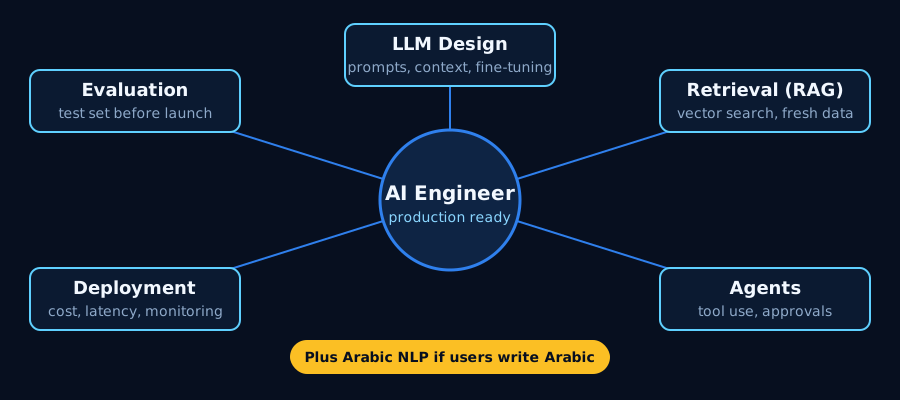
A good AI engineer can take a language model from a demo to a system that runs in production. That needs five skills: LLM application design, retrieval (RAG), agent orchestration, deployment and monitoring, and evaluation. Test for all five. Skill in one area does not carry over to the others.
Which core skills should you test for?
- LLM application design: prompt and context engineering, fine-tuning choices, and knowing when a model is the wrong tool. Our generative AI and LLM service shows what this looks like in delivery.
- Retrieval and data work: vector search, chunking, and the pipelines that keep data fresh.
- Agent orchestration: multi-step tool use, approvals and fallbacks. See how this works in AI agents and orchestration.
- Deployment and monitoring: cost control, latency, drift checks and rollback plans.
- Evaluation: a repeatable test set that proves the system works before real users see it.
Why is Arabic NLP the scarce skill in the Gulf?
In our experience, many engineers have built English language systems. Far fewer have shipped Arabic ones. Arabic has dialects, mixed Arabic and English messages, and right-to-left text issues that break tools built for English. A model that scores well in English can fail in a UAE customer chat.
If your users write in Arabic, ask each candidate for a live Arabic system they built and how they measured it. Read our guide to native Arabic NLP for GCC chatbots for the tests to run.
Should you hire a generalist or a specialist?
Hire a generalist for a first project. One engineer who can cover retrieval, prompts and deployment gets a pilot live. Hire a specialist when you hit a specific wall, such as slow retrieval, weak Arabic output or rising model cost. The wall tells you which specialist you need.
How Long Does Staffing an AI Engineer in the UAE Really Take, and What Slows It Down?
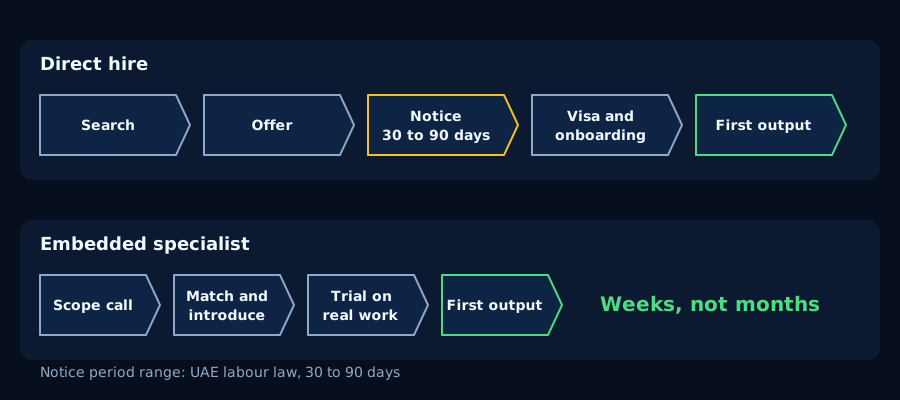
A direct hire usually takes one to two quarters from first search to first useful output. We do not have a single published figure for the UAE, so treat that as a planning range, not a fact. The delays are structural, and you can plan around them.
What slows a direct hire?
- Search and screening: senior AI engineers get many offers, and a slow interview process loses them to faster companies.
- Notice periods: UAE labour law sets a notice period of 30 to 90 days for private-sector staff. A strong candidate rarely starts before it ends.
- Relocation: a candidate abroad needs a work permit and a residence visa. The UAE also runs a Golden Visa for specialists in priority fields, valid for 5 or 10 years without a sponsor, which helps with retention but adds paperwork.
- Onboarding: access to data, security checks and tool setup can take weeks even after the contract is signed.
Where can you save time?
Write the role down before you search. Define the problem, the stack, the data and the first deliverable. Vague roles attract the wrong candidates and slow every interview. A clear brief also lets you test candidates with a real task instead of trivia.
Run a paid trial on a scoped piece of work. Two weeks of real output tells you more than five interviews. Our own process works this way: scope the role, match a named engineer, trial on real work, then scale or convert.
What does a slow hire really cost?
The cost is delay, not salary. Every month without the skill is a month your pilot stays a pilot. Competitors who launch first collect the feedback, the data and the customers. For a project tied to a market window, speed often matters more than the lowest rate.
When Does an Embedded AI Engineer Beat a Full Project Team?
An embedded engineer wins when the gap is narrow, your team can lead, and the deadline is close. A full project team wins when the system is large, the scope is new to you, or no one on your side can direct the work. The deciding question is who owns the roadmap.

When is an embedded specialist the better choice?
- You have a product team and developers, but no one who has shipped an LLM feature to production.
- You need to add Arabic NLP skill to an existing product without a long search.
- You have a fixed-term gap during a critical launch and do not want a permanent hire.
- You want an expert review of your architecture before you commit to a full build.
When is a full project team the better choice?
Pick a team when the system spans many parts: data pipelines, model work, integrations, security review and a user interface. One engineer cannot cover that and still finish on time. A team also suits firms with no AI product owner, because the vendor supplies the planning. For build cost ranges by tier, see our AI agent development cost guide.
What does the first month of an embedded engagement look like?
Week one is scoping and access. The engineer reads your code, your data and your goals. The following weeks are a trial on one bounded task, such as a retrieval fix or an evaluation set. You judge the work directly. If it fits, you extend the term, add engineers, or convert to a full delivery project. If it does not, you stop with little lost.
Bounce Technologies has delivered more than 50 projects over 10 years, and the same delivery process sits behind every placed engineer. That is the main difference from a freelance marketplace profile.
What Should You Ask Before You Commit to an AI Engineer or Consultant?
Ask for proof of production work, not demos. A strong candidate or vendor can name a system that is live, explain how it was tested, and describe what broke. Weak ones talk about tools. Strong ones talk about outcomes, failures and trade-offs.
Which questions separate strong candidates from weak ones?
- What AI system have you shipped to real users, and how did you measure it?
- How do you test an LLM feature before launch, and what did your last test catch?
- How do you control model cost and latency once usage grows?
- How do you handle personal data, access and logging in a regulated setting?
- Can you work with Arabic and English input, and what evidence do you have?
- Who owns the code, the prompts and the evaluation data at the end?
- Who covers if you become unavailable mid-project?
What are the red flags?
- A rate quote before anyone asks what you are building.
- No live system to show, only slides or a demo video.
- A vague answer on who actually does the work, or a different team from the one you met.
- No plan for testing, monitoring or rollback.
- Pressure to sign before a trial or a scoped first task.
Ask who will be at the keyboard on day one. If the answer is a person you can meet, interview and test, you are hiring. If it is a process, you are buying.
Where does an AI consultant fit?
A consultant advises before you build. Use one when you need a roadmap, a build or buy decision, or a readiness check. Use an engineer when the decision is made and the system must be built. Some firms combine both. See our AI consulting service for how advisory work is scoped.
Frequently asked questions
Is an in-house AI team or an agency better in the UAE?
It depends on duration. In-house suits permanent AI work with several projects planned. An agency suits one defined system with a clear end date. An embedded specialist sits between them and suits a team that is missing one senior skill and needs it within weeks.
How long does it take to bring an AI engineer on board in Dubai?
Plan for one to two quarters for a direct hire. The search, offer, onboarding and a legal notice period of 30 to 90 days for candidates already working in the UAE private sector all add time. An embedded specialist can start sooner because the search is done for you.
What skills should an AI engineer have for LLM and RAG projects?
Look for LLM application design, retrieval and vector search, agent orchestration, deployment and monitoring, and evaluation. Add Arabic NLP if your users write in Arabic. Ask for a live system that uses these skills, not a demo.
Can I hire an AI consultant instead of an engineer?
Yes, if you need advice before building. A consultant covers roadmap, build or buy choices and readiness checks. An engineer builds the system. Many projects need a consultant first, then an engineer once the plan is set.
How much does it cost to hire an AI engineer through Bounce Technologies?
Cost depends on seniority, specialization and time commitment, from part-time advisory to full-time embedded. We fix the terms after a short scoping call instead of publishing a day-rate card. That keeps the price tied to your actual scope.
Want this built for your team?
We ship production-grade AI like this across every industry, in weeks, not months.