
AI Call Answering in the UAE: What to Automate and What to Route
Most AI call answering pitches in the UAE start from the wrong end: replace your receptionist, deflect your call volume, cut your headcount. The evidence points the other way. UAE consumers say clearly and repeatedly that they want to reach a person. So the systems that actually work here are not the ones that answer the most calls. They are the ones that catch the calls currently ringing out unanswered, finish the handful that genuinely need no human, and hand everything else to a person who already knows why the phone rang.
 By: Asad Siddiq
Start with the number that should shape the whole project. In a poll of 1,000 UAE residents run through YouGov, 90% said they prefer genuine human customer support over chatbots or AI, with 85% wanting businesses reachable on WhatsApp. A separate 2025 study of 1,000 UAE consumers found at least 68% prefer to interact with people, and 47% say their AI chatbot interactions have not met expectations. Two independent samples, the same signal. A system designed to keep callers away from your team is fighting the market it is selling into. Our voice AI agents work in the UAE is scoped around that reality rather than against it.
What Problem Does AI Call Answering Actually Solve?
Not call volume. Unanswered call volume. Those are different problems with different economics, and conflating them is why so many deployments disappoint the person who signed off on them.
The calls you already answer are not the opportunity
A call answered by your team in business hours is already working. Automating it moves a satisfied caller into a worse experience and calls the result a saving. The measurable gain sits in the calls nobody picked up: after hours, during prayer times, over the weekend, while your one person on the desk was already on another line.
What an unanswered call actually costs
For a service business, an unanswered call is rarely a caller who waits patiently. It is a caller who dials the next result in the search listing. That cost is invisible in every report you run, because the call left no record beyond a missed-call log nobody reads. The first genuinely useful thing an AI system does is turn that silence into a logged, categorised, followed-up enquiry.
Why after-hours matters more in the GCC
Business hours across the UAE, Saudi Arabia and Qatar do not line up neatly, weekends differ from the Western pattern, and buyers routinely call outside your published hours because that is when they are free. A line that only works between 9 and 6 on your calendar is closed for a large share of the moments people actually reach out.

Which Calls Should AI Finish, Capture, or Route?
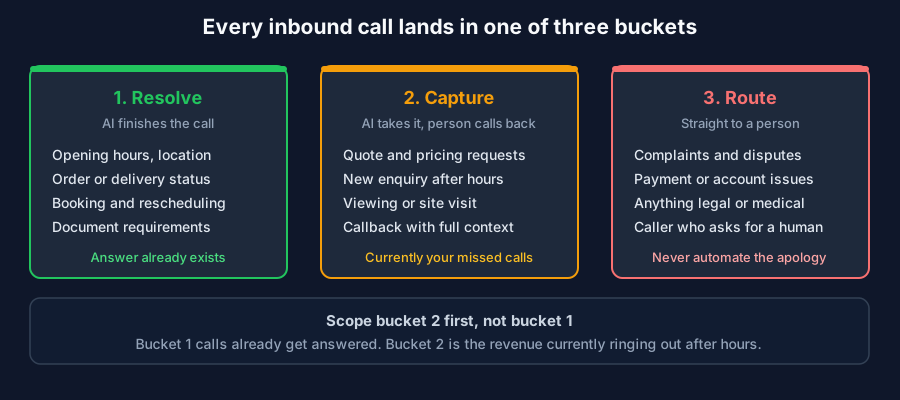
Sort every inbound call into three buckets before you evaluate a single vendor. The bucket decides the design, and getting this wrong is the most expensive mistake in the project.
Bucket 1: resolve, where the answer already exists
Opening hours, location and parking, order or delivery status, document requirements, booking and rescheduling. The answer is a fact in a system or a document, the caller wants it in ten seconds, and no judgement is involved. These are safe to complete end to end, and they are also the calls your team least minds losing.
Bucket 2: capture, where a person calls back
Quote requests, new enquiries after hours, viewing or site-visit bookings, anything commercial. The AI does not try to close. It confirms who is calling, what they need, how urgent it is, and when they can be reached, then puts a complete brief in front of a human the next working morning. This bucket is where the revenue is, and it is almost entirely made up of calls you are currently missing.
Bucket 3: route, where automation should not try
Complaints, disputes, payment and account problems, anything legal or medical, and any caller who asks for a person. The UAE research above is unambiguous on this: only 13% of consumers would trust AI to dispute a suspicious transaction on their account, against 43% who want to handle it in person. Never automate the apology.
Why Is the Handoff More Important Than the Deflection Rate?
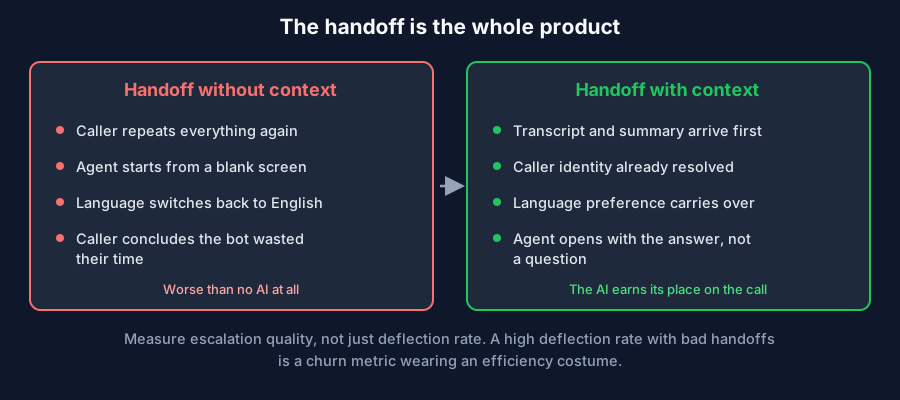
Because deflection rate measures how many callers you kept away from your team, and that is not the thing you are trying to buy. A high deflection rate produced by a system that frustrates callers into hanging up looks identical, in the dashboard, to one produced by a system that genuinely helped.
What a bad handoff does to the call
The caller explains the problem to the AI, waits, gets transferred, and is asked to explain it again from the beginning. That call is now worse than if the phone had simply rung through to a person. The AI did not save a step, it added one, and the caller will remember that the next time they see your name.
What the handoff has to carry
The transcript and a short summary of what has happened so far, the caller's identity resolved against your records, the reason for the call, and the language they have been speaking. The agent should open with an answer, not a question. Design this before you design the conversation, because everything upstream exists to make this moment work.
The numbers worth watching instead
Share of previously unanswered calls now captured, callback rate on captured enquiries, escalation rate with full context attached, and repeat-contact rate within 48 hours. That last one is the honest one: if callers keep phoning back about the same thing, the system is deflecting rather than resolving, whatever the headline number says.
How Should the Line Handle Arabic and English?
Natively, in both, and without asking the caller to choose from a menu first. Language handling is where most call answering deployments in the GCC quietly fail, because it is the part that demos perfectly in English and falls apart on a real call.
Code-switching is normal here, not an edge case
A caller in Dubai will start a sentence in Arabic, name a product or a street in English, and finish in Arabic. A system that locks to one language at the start of the call, or routes on a press-one-for-Arabic menu, breaks on the most ordinary conversation in the market. Native Arabic handling means the model was trained for this, not translated into it.
Dialect, not just Modern Standard Arabic
Most publicly available Arabic training data is Modern Standard Arabic drawn from news and official text. Callers do not speak that. A system evaluated only on MSA will read beautifully in a demo and mishear Gulf dialect on live calls, which shows up as wrong details captured rather than as an obvious failure.
Carry the language choice into the callback
If someone called in Arabic, the callback, the SMS and the WhatsApp follow-up should be in Arabic too. This sounds obvious and is routinely missed, because the capture system and the CRM are usually built by different people at different times.
What Should You Check Before Signing With a Vendor?
Most evaluation checklists test the conversation. The conversation is the easy part to demo and the least predictive of how the deployment lands. For the broader set of signals worth checking on any AI vendor, not just a voice AI one, see our 10-signal evaluation guide.
Ask about the failure path, not the happy path
What happens when the model is unsure, when the caller interrupts, when the line quality is poor, when a name is spelled out, when the caller asks for a person three seconds in. A vendor who only shows you clean calls is showing you the part that always works.
Ask what integrates and what does not
Where does a captured enquiry land: a CRM record, an email, a spreadsheet nobody opens? Can it check real availability before it books, or does it promise a slot the calendar has already given away? A capture system that does not write into the tools your team already uses creates a second inbox instead of removing one.
Ask where recordings and transcripts live
Call recordings and transcripts are personal data. Handling in the UAE falls under Federal Decree-Law No. 45 of 2021 on the Protection of Personal Data, and where that data is processed and stored should be settled in writing before build, not discovered at renewal. If your sector carries its own residency requirements, that answer narrows the vendor list immediately.
Ask how it sounds, then ignore how it sounds
Voice quality matters, and it is also the thing every vendor has already optimised for the demo. The engineering that separates a good voice agent from a bad one sits in latency, turn-taking and grounding, not in the warmth of the sample recording you were played.
Deflection rate tells you how many people you kept away from your team. It tells you nothing about whether any of them got what they called for.
How Long Does a First Deployment Take?
A single line, a single language pair, and one bucket of calls is a matter of weeks, not quarters. The scoping conversation takes longer than the build if the three buckets have not been agreed first.
Start with capture, not resolve
Bucket 2 is the fastest thing to prove and the easiest to measure, because the baseline is zero. Every captured enquiry is one your business demonstrably did not have last month, which makes the internal case for the next phase without an argument about attribution.
What the second phase reuses
The telephony integration, the CRM write-path, the Arabic handling and the escalation route are the same components bucket 1 needs. That is why resolve is cheaper as a second step than as a first, even though every vendor deck leads with it.
What Is the Bottom Line for UAE Businesses?
Buy an AI call answering system to stop losing the calls you never hear about, not to keep callers away from your team. Sort your calls into resolve, capture and route before you look at a demo. Scope capture first, insist the handoff carries transcript, identity and language, and hold the vendor to the failure path rather than the sample call.
The UAE market has told anyone who asked that it wants to reach a person. The systems that succeed here are the ones that take that seriously and use automation to get callers to the right person faster, with the context already in hand.
Frequently asked questions
What are AI call answering solutions for UAE businesses?
They are systems that pick up inbound calls your team cannot, handle them in Arabic and English, and either complete a simple request, capture a full enquiry for callback, or route the caller to a person with context attached. The practical value sits in after-hours and overflow calls that currently ring out unanswered rather than in replacing staff on calls already being handled.
Will an AI answer every call instead of my staff?
It should not. UAE consumer research is consistent that callers want people: a YouGov poll of 1,000 UAE residents found 90% prefer human support, and a 2025 study of 1,000 UAE consumers found at least 68% prefer to interact with people. Automate only calls where the answer already exists and no judgement is involved, capture commercial enquiries for a human callback, and route complaints, disputes and account issues straight to a person.
Can an AI call answering system handle Arabic and English on the same call?
It has to, without a press-one-for-Arabic menu. Callers in the UAE routinely code-switch mid-sentence, naming a product or street in English inside an Arabic sentence. The system needs native Arabic handling rather than translation, trained on Gulf dialect rather than only Modern Standard Arabic, and the language the caller used must carry into the callback, SMS and WhatsApp follow-up.
How do you measure whether AI call answering is working?
Track the share of previously unanswered calls now captured, callback rate on those enquiries, escalation rate with full context attached, and repeat-contact rate within 48 hours. Avoid buying on deflection rate: a system that frustrates callers into hanging up produces the same deflection number as one that genuinely resolved the call.
Where are call recordings and transcripts stored?
Recordings and transcripts are personal data, handled in the UAE under Federal Decree-Law No. 45 of 2021 on the Protection of Personal Data. Settle where that data is processed and stored before build starts, on-premise, in a UAE-hosted private cloud, or offshore. If your sector carries its own residency requirements, that answer narrows the vendor list immediately.
How long does a first AI call answering deployment take?
A single line, one language pair and one bucket of calls takes weeks rather than quarters. Starting with enquiry capture is fastest to prove because the baseline is zero, and the telephony integration, CRM write-path, Arabic handling and escalation route it establishes are the same components the next phase reuses.
What should I ask a call answering vendor in a demo?
Ask about the failure path rather than the happy path: what happens when the model is unsure, the caller interrupts, line quality is poor, a name is spelled out, or the caller asks for a person three seconds in. Also ask where a captured enquiry actually lands, and whether the system checks real availability before it books anything.
Want this built for your team?
We ship production-grade AI like this across every industry, in weeks, not months.